
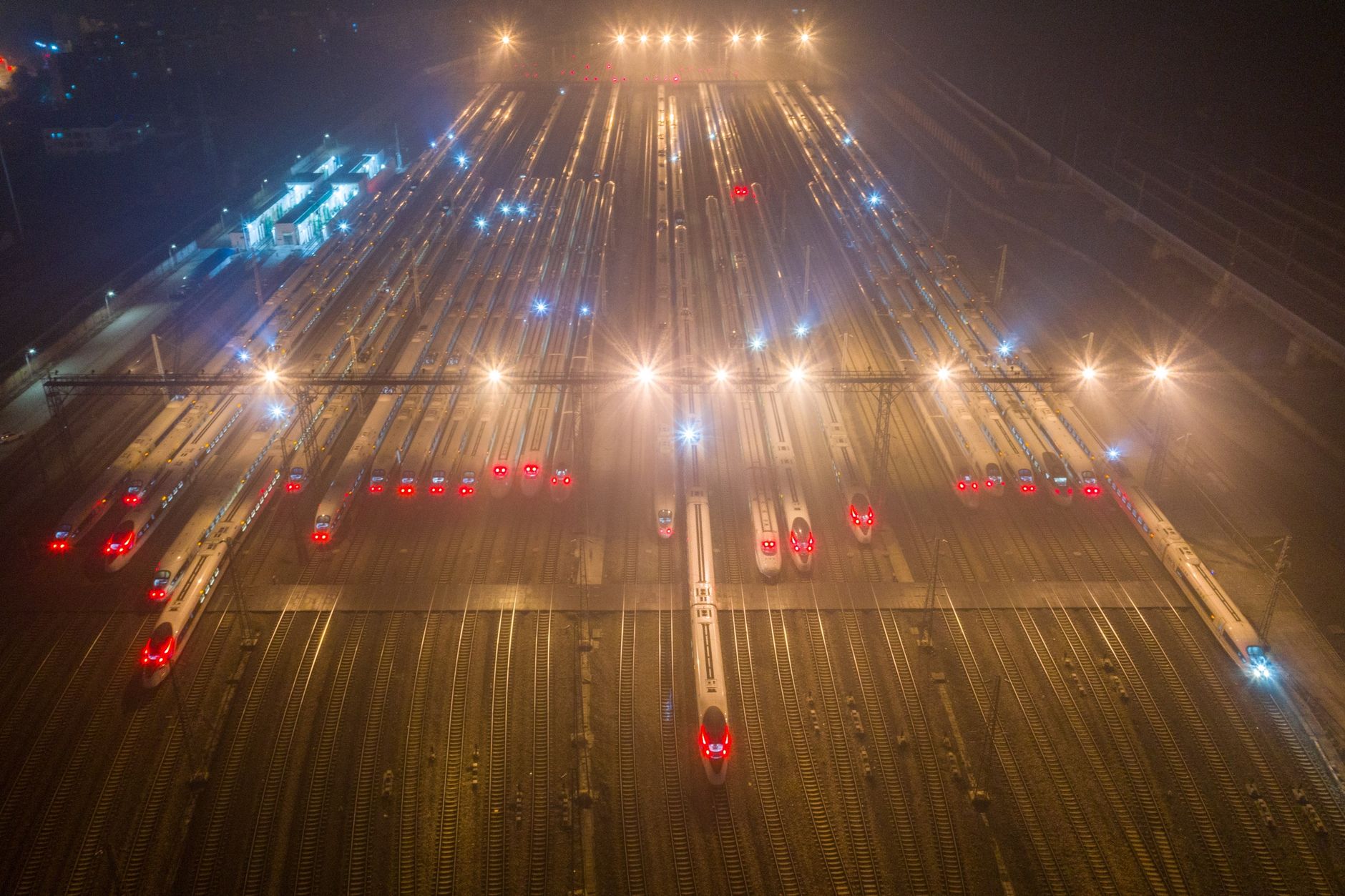
If you have ever ridden a subway in Boston, Los Angeles, Chicago, or Washington D.C., there is a reasonable chance you were sitting in a train car built by CRRC — a state-owned Chinese company that most Westerners have never heard of. The same is true if you boarded a metro in London, São Paulo, Buenos Aires, or Sydney. CRRC Corporation Limited (中国中车股份有限公司), headquartered in Beijing, is the world’s largest manufacturer of rail transit equipment, with annual revenues exceeding $30 billion and a production scale that dwarfs every Western competitor combined.
Understanding CRRC is not just about rail infrastructure. It is a window into how China builds global industrial champions through state support, patient capital, massive domestic scale, and a calculated international expansion strategy. For foreign companies across construction, engineering, logistics, and urban planning, CRRC is both a case study and a commercial counterpart worth knowing.
How CRRC Was Built: Mergers, Scale, and State Strategy
CRRC was formed in June 2015 through the merger of CNR Corporation (北车) and CSR Corporation (南车), the two dominant state-owned rail manufacturers that had been competing with each other on the global stage — often undercutting each other’s bids in third-country markets. Beijing decided this was wasteful. By combining the two into a single national champion, it created an entity with the manufacturing capacity, R&D resources, and negotiating leverage to compete head-to-head with Siemens, Alstom, Bombardier Transportation (now Alstom), and Kawasaki Heavy Industries.
The merger was not just about eliminating domestic competition. It followed a deliberate industrial policy logic embedded in China’s “Made in China 2025” roadmap, which targeted rail equipment as a strategic sector. Prior to the merger, both CNR and CSR had separately developed technology partnerships with foreign companies — Siemens licensed high-speed rail technology to CNR in the early 2000s, and Alstom licensed technology to CSR. China used those partnerships to absorb technical knowledge, develop domestic expertise, and eventually build proprietary platforms. The CRH series of high-speed trains, which now run at speeds up to 350 km/h on China’s 45,000-kilometer high-speed rail network, are the commercial product of that knowledge transfer and indigenous development.
The Numbers: An Industrial Scale Unlike Any Other
CRRC’s scale is difficult to overstate. The company operates more than 40 manufacturing facilities across China and employs approximately 175,000 people. In 2023, CRRC reported revenue of roughly 232 billion Chinese yuan (approximately $32 billion USD), making it larger by revenue than Siemens Mobility, Alstom, and Hitachi Rail combined. Its domestic market advantage is structural: China’s state railway operator, China Railway (中国国家铁路集团, CR), has invested more than $900 billion USD in rail infrastructure since 2008. That spending flow goes almost exclusively to CRRC, providing a guaranteed revenue base that no Western competitor can match at home.
Between 2016 and 2023, CRRC secured contracts across six continents. Notable deals include $1.3 billion in subway car contracts for the Massachusetts Bay Transportation Authority (MBTA), $647 million for the Chicago Transit Authority (CTA), and contracts for metro systems in Los Angeles, Washington D.C., and Philadelphia. In emerging markets, CRRC has won locomotive and passenger car contracts in Ethiopia, Nigeria, Egypt, Malaysia, Mexico, and Brazil. The company’s pricing — typically 20 to 40 percent below European competitors on comparable specifications — has proven decisive in competitive procurement processes.
Localization Strategy: Manufacturing in the United States
CRRC’s US expansion drew intense scrutiny, and the company responded with a localization strategy that temporarily neutralized critics. For its MBTA contract, CRRC established a manufacturing facility in Springfield, Massachusetts — CRRC MA LLC — that employed American workers building rail cars on American soil. The company made similar moves in Chicago (CRRC Sifang America) and partnered with local engineering firms for compliance and testing requirements.
The political environment eventually shifted against these arrangements. The National Defense Authorization Act (NDAA) for fiscal year 2020 barred federal transit funding from being used to purchase rolling stock from Chinese state-owned manufacturers. Subsequent legislative action in 2022 and 2023 tightened those restrictions further. CRRC’s active US procurement pipeline was effectively frozen, and the Springfield facility transitioned to servicing existing contracts rather than pursuing new ones.
This is important context for foreign business professionals: CRRC’s US experience illustrates the tension between pure commercial logic and the national security considerations that increasingly shape procurement policy in Western democracies. Huawei faced comparable restrictions in telecommunications infrastructure, and the underlying policy dynamic — state-backed Chinese companies competing in sensitive infrastructure markets — continues to be a live issue in the US, EU, UK, and Australia.
International Markets Where CRRC Is Winning
Outside the United States, CRRC’s international expansion continues at pace. The company has been the most active beneficiary of China’s Belt and Road Initiative in the rail sector, supplying locomotives and passenger rolling stock to BRI-linked projects across Southeast Asia, Central Asia, Africa, and Latin America. China’s Belt and Road Initiative has created a pipeline of rail infrastructure projects where CRRC is the default supplier, often bundled with Chinese state financing from the Export-Import Bank of China or China Development Bank.
Key active markets include:
- Southeast Asia: CRRC supplied electric multiple units (EMUs) for Malaysia’s Klang Valley Mass Rapid Transit and has pending contracts in Indonesia and the Philippines.
- Africa: The company has supplied diesel locomotives and passenger coaches to Ethiopia, Nigeria, Tanzania, and South Africa, often linked to Chinese-financed railway construction projects.
- Latin America: CRRC won a $1.4 billion contract in 2019 for metro cars for São Paulo’s Line 6 and has maintained a presence in Argentina and Chile.
- Europe: European procurement is more complex due to Technical Specifications for Interoperability (TSI) and the European Union Agency for Railways (ERA) certification requirements. CRRC has been working through European subsidiaries — including CRRC Qingdao Sifang’s Austrian entity — to meet these requirements. An EU investigation launched in 2023 scrutinized state subsidies in the procurement of CRRC trains in Bulgaria, raising the prospect of a broader EU instrument against subsidized Chinese rolling stock.
Technology Trajectory: High-Speed, Hydrogen, and Autonomous Rail
CRRC is not standing still technically. The company’s CR400AF/BF series of high-speed trains, operated commercially by China Railway, holds the world record for sustained high-speed rail operations at scale. CRRC has also developed the Fuxing autonomous train platform, which integrates driver assistance, condition monitoring, and predictive maintenance systems. In 2021, CRRC unveiled a hydrogen-powered tram in Qingdao — a fuel-cell powered vehicle with a 600-kilometer range — signaling ambitions in zero-emission urban transit well ahead of Western competitors.
For Western rail operators and transit authorities evaluating fleet renewal, CRRC’s technology portfolio is now genuinely competitive, not merely cheap. The procurement question has shifted from “can Chinese trains meet our technical standards?” to “what are the security, supply chain, and geopolitical risks of buying them?” This is a substantively different and more complex conversation, one that is playing out differently in Tokyo, Berlin, London, and Washington.
What This Means for Foreign Businesses
For companies involved in rail supply chains, component manufacturing, engineering services, or urban transit consulting, CRRC’s dominance creates both challenges and opportunities.
Supply chain suppliers: CRRC’s global operations require tens of thousands of components — braking systems, couplers, HVAC units, signaling equipment, and passenger amenity systems — sourced from international vendors. Western companies with rail-qualified components have active opportunities to supply CRRC’s international project divisions, particularly in markets where local content requirements or technology preferences create openings. Like COSCO in maritime shipping, CRRC increasingly requires global supply chain partners for its international project execution.
Technology licensing and joint ventures: In markets where CRRC pursues local manufacturing partnerships — as it has in South Africa through a joint venture with Gibela Rail Transport Consortium — there are opportunities for Western engineering firms to participate as technology licensors or system integrators.
Consulting and advisory services: The complexity of operating Chinese-sourced rail equipment within Western regulatory frameworks creates ongoing demand for independent engineering, compliance, and maintenance expertise. Transit authorities that have purchased CRRC equipment — including those that did so before NDAA restrictions took effect — require third-party maintenance and lifecycle support services.
Competitive intelligence: Any company tendering for infrastructure or rolling stock contracts globally is likely to encounter CRRC in the same bid process. Understanding CRRC’s pricing structure, financing instruments, after-sales service model, and localization playbook is essential competitive preparation. Understanding China’s steel industry provides useful parallel context — state-backed pricing advantages in one sector often mirror structures in adjacent capital-intensive industries.
The Regulatory and Policy Landscape in 2026
The US effectively closed its doors to CRRC equipment through the NDAA process. The EU is moving in a similar direction through its International Procurement Instrument (IPI), which allows the EU to restrict access to its public procurement markets for companies from countries that deny reciprocal access. China’s rail procurement market — where CRRC holds a near-monopoly — provides the legal basis for applying the IPI. The European Commission has also launched a Foreign Subsidies Regulation investigation into CRRC’s bid for a Bulgarian rolling stock contract, which could set a precedent for future exclusions.
For reference, the US Federal Transit Administration maintains Buy America requirements and guidance that govern rolling stock procurement for federally funded transit projects, and the NDAA’s Section 3539 restrictions on Chinese-manufactured rolling stock are summarized in the Congressional Research Service’s transit manufacturing reports. On the Chinese side, the CRRC Corporation official investor relations site provides annual reports, technical specifications, and international project documentation.
The Bottom Line
CRRC is the COSCO or Huawei of the rail industry: a state-backed Chinese champion that has achieved genuine global scale by combining policy support, domestic volume, and aggressive international pricing. Its trajectory over the next decade will be shaped by two competing forces — the continued expansion of global rail infrastructure investment (particularly in developing markets) and the tightening of procurement restrictions in Western democracies concerned about critical infrastructure security and fair competition.
For business professionals, the key insight is this: CRRC is too large and too technically capable to ignore. Whether you are a supplier seeking a new customer, a transit authority evaluating procurement options, a policy consultant advising on industrial competition, or an investor analyzing the global rail equipment market, CRRC sits at the center of the conversation. The company that builds most of the world’s trains has made the procurement of rail equipment a matter of international trade policy — and that intersection of commerce and geopolitics is precisely where GreatHandshake operates.