
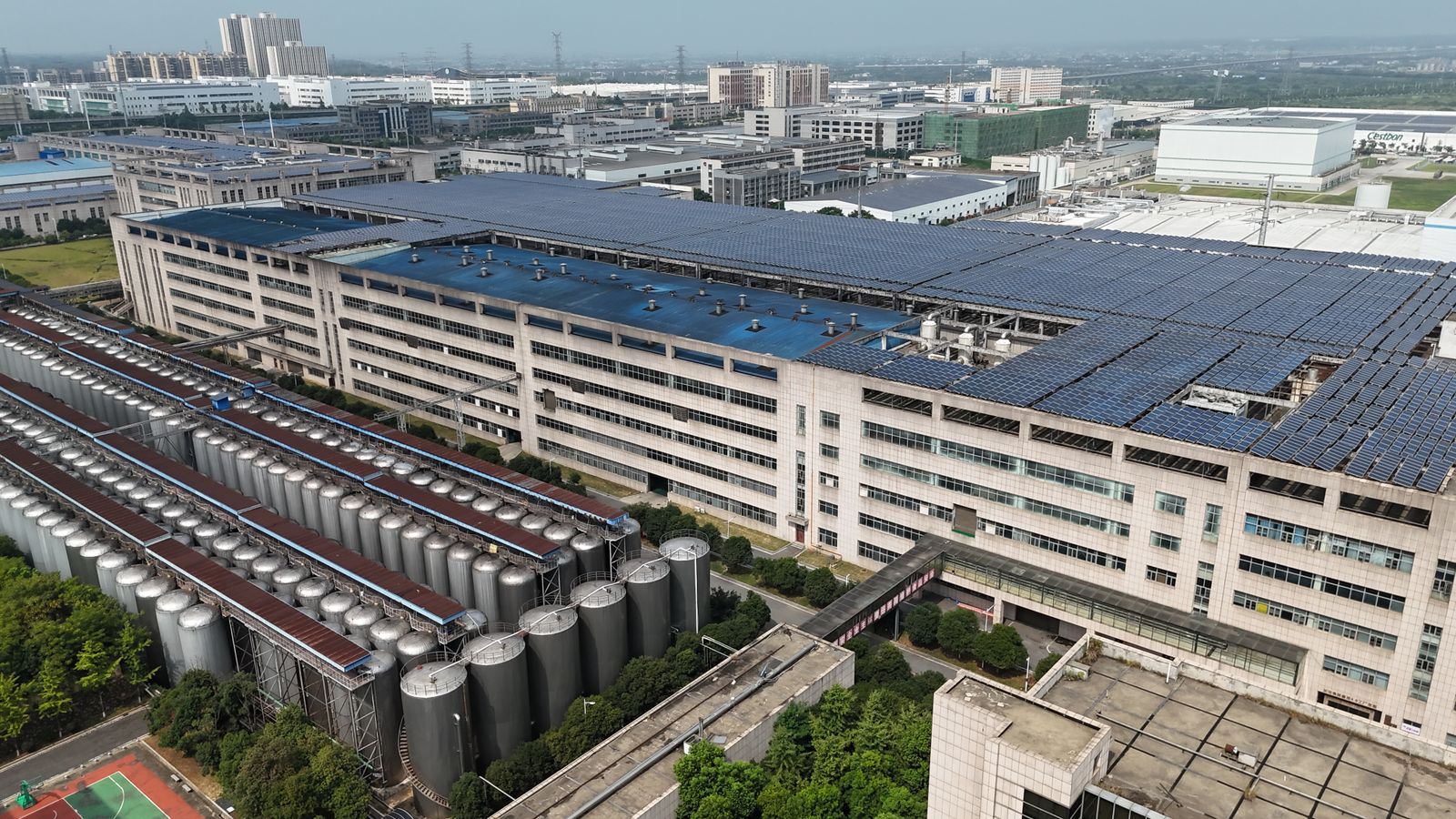
China did not invent the solar panel. But over two decades, Chinese manufacturers turned a niche technology developed in American and European labs into the cheapest form of electricity generation in human history. Today, China produces roughly 80% of the world’s solar panels, controls the majority of the global polysilicon supply chain, and has driven module costs down by more than 90% since 2010. For Western businesses — sourcing components, evaluating clean energy investments, or managing supply chain exposure — understanding how China built this dominance is essential context for the decade ahead.
The Origins: Borrowed Technology, Relentless Scale
China’s solar story begins with Shi Zhengrong, who studied photovoltaic research at the University of New South Wales and founded Suntech Power in Wuxi in 2001. At its peak, Suntech became the world’s largest solar panel manufacturer before going bankrupt in 2013 when European feed-in tariff subsidies collapsed. Its rise and fall set the pattern: rapid scaling, aggressive pricing, and acute exposure to subsidy cycles.
The companies that survived those cycles — LONGi Green Energy, Jinko Solar, Trina Solar, and JA Solar — are now the global leaders. LONGi, headquartered in Xi’an, is the world’s largest solar manufacturer by revenue, reporting approximately 128 billion yuan ($17.6 billion) in 2023. The company holds multiple world records for silicon cell efficiency. Jinko Solar (NYSE: JKS) shipped 78.5 gigawatts of modules in 2023 alone — a figure that would have been inconceivable a decade ago.
The Policy Engine: How Beijing Built an Industry
Chinese industrial policy was decisive at every stage. Provincial governments competed to attract solar manufacturers with land grants, preferential electricity rates, and state-bank financing. The NDRC and MIIT coordinated capacity targets and technology cycles. China’s 12th Five-Year Plan designated solar a strategic emerging industry, unlocking billions in capital.
By end-2023, China had crossed 600 gigawatts of cumulative installed solar capacity — more than the rest of the world combined — according to the National Energy Administration of China. Critically, China also captured roughly 80% of global polysilicon production. Domestic producers including Tongwei, GCL-Poly, and Daqo New Energy drove polysilicon prices from over $400 per kilogram in 2008 to below $7 per kilogram in 2023, structurally lowering costs for the entire global solar value chain.
Vertical Integration as a Competitive Moat
What distinguishes China’s solar sector is the depth of vertical integration. A company like LONGi or Jinko can source polysilicon from domestic suppliers, produce silicon ingots, slice wafers, process cells, and assemble finished modules — entirely within China’s supply chain. This compresses cost at every stage and creates a structural price advantage that non-integrated foreign competitors cannot easily close through technology alone.
The implications for global trade are significant. The U.S. Department of Energy’s Solar Futures Study — available at energy.gov — projects solar could supply 40% of U.S. electricity by 2035. Achieving that requires roughly one terawatt of new capacity, most of which still depends on Chinese-manufactured components. The tension between clean energy ambition and supply chain diversification defines the current policy debate in Washington and Brussels alike.
The Uyghur Forced Labor Prevention Act (UFLPA), signed in December 2021, introduced rebuttable presumption rules for goods manufactured in Xinjiang — a region producing a significant share of China’s polysilicon. Western solar developers now face real compliance burdens around supply chain traceability. This is an area where rigorous supplier auditing and legal counsel are non-negotiable for U.S. and European project developers. The broader compliance context is covered in our overview of China’s critical supply chain dominance.
Third-Country Manufacturing and Trade Remedy Risk
In response to U.S. anti-dumping and countervailing duty cases beginning in 2012, Chinese manufacturers shifted assembly operations to Vietnam, Malaysia, Cambodia, and Thailand — enabling sales into the U.S. market at lower duty rates while maintaining Chinese upstream components. The U.S. Commerce Department has repeatedly investigated these arrangements for circumvention. A two-year tariff moratorium issued in June 2022 temporarily sheltered solar developers, but the underlying policy tension is unresolved.
For importers and project developers, tracking the status of trade remedy cases — available through the U.S. International Trade Administration — is an operational necessity. The tariff environment covered in our analysis of US-China trade in 2026 shapes every procurement decision in this sector.
The Technology Frontier: TOPCon and Perovskite
Chinese manufacturers are not resting on commodity production. The industry has largely upgraded from PERC to TOPCon (Tunnel Oxide Passivated Contact) cell architecture, delivering higher efficiency at comparable cost. LONGi set a laboratory efficiency record of 26.81% for a crystalline silicon cell in November 2023, approaching the theoretical maximum for silicon-based photovoltaics.
The more disruptive frontier is perovskite solar cells — capable of exceeding 30% efficiency in tandem configurations — which can be manufactured using thin-film deposition requiring less silicon. Chinese research institutions including Peking University and the Chinese Academy of Sciences have published leading research in this area, and LONGi, Jinko Solar, and GCL have active commercial development programs. If perovskite achieves commercial-scale durability, the transition will likely be led by companies already embedded in the Chinese manufacturing ecosystem.
What Western Businesses Need to Know
Module pricing is a China story
Global solar module prices track Chinese manufacturers’ cost structures. When polysilicon prices spike in China — as in 2021 — global module prices follow. When Chinese overcapacity drives polysilicon to multi-year lows — as in 2023-2024 — module prices collapse globally. Procurement teams at solar developers should track Chinese polysilicon spot prices as a leading indicator.
Supply chain compliance has real teeth
U.S. Customs and Border Protection detained hundreds of solar shipments under the UFLPA in 2022-2023. Companies importing solar equipment into the United States need traceable supply chain documentation — from polysilicon feedstock through to the finished module. Suppliers unwilling to provide this documentation present material legal risk.
Chinese manufacturers remain viable long-term partners
Despite geopolitical friction, LONGi, Jinko Solar, and Trina Solar have demonstrated consistent technology leadership, reliable delivery, and improving ESG disclosure. The due diligence framework for working with these companies should be rigorous — covering compliance, counterparty risk, and supply chain transparency — but the bilateral commercial relationship remains economically essential. This mirrors the sourcing dynamics covered in our post on adapting sourcing strategy in China’s manufacturing shift.
U.S. domestic manufacturing is growing but not a near-term substitute
The Inflation Reduction Act’s production tax credits have spurred over $100 billion in announced U.S. solar manufacturing investments, with expansions from First Solar, Qcells, and others. But current domestic capacity remains a fraction of installation demand. The gap between policy ambition and production reality is measured in years, not months.
The Bigger Picture
China’s solar industry is among the most consequential examples of state-directed industrial policy in modern economic history. Starting from near-zero market share in 2000, Chinese manufacturers used scale, vertical integration, policy support, and technology investment to build global dominance — while materially accelerating the clean energy transition and creating supply chain dependencies that will define sector geopolitics for years.
For Western professionals — whether energy developers, importers, investors, or policymakers — the imperative is the same: understand the Chinese industry on its own terms, engage with leading companies through proper compliance frameworks, and build supply chain resilience without abandoning the bilateral commercial relationships that make affordable clean energy possible at scale. The world’s solar future was, to a significant degree, made in China. For the current tariff and trade policy framework governing solar imports, the US Trade Representative (USTR) publishes ongoing updates on Section 201 and Section 301 measures affecting the sector.