
When China announced the Belt and Road Initiative (BRI) in 2013, many Western analysts dismissed it as vague political rhetoric. Thirteen years later, it is the most consequential infrastructure investment program in modern history — a $1 trillion-plus network of ports, railways, pipelines, and digital corridors that has fundamentally rewired global trade routes. Understanding how the BRI has reshaped physical and financial infrastructure is not optional for businesses in international trade. It is essential due diligence.
What the Belt and Road Initiative Actually Is
The BRI — officially comprising the “Silk Road Economic Belt” and the “21st Century Maritime Silk Road” — is China’s framework for financing and building infrastructure across Asia, Africa, Europe, and Latin America. Announced by President Xi Jinping in Astana, Kazakhstan in September 2013, it now encompasses over 150 countries and has facilitated more than $1 trillion in infrastructure investment commitments, according to the World Bank’s BRI research program.
The initiative is not a single program administered by a single body. It is a policy framework under which Chinese state-owned banks — primarily the Export-Import Bank of China and the China Development Bank — extend sovereign loans to developing countries for infrastructure projects, often executed by Chinese SOEs such as China Communications Construction Company (CCCC), China Harbour Engineering Company (CHEC), and China Railway Group Limited (CREC).
The geographic scope breaks into several corridors: the China-Pakistan Economic Corridor (CPEC), the China-Europe Land Bridge via Central Asia, the Maritime Silk Road connecting Chinese ports to Southeast Asia, East Africa, and the Mediterranean, and the Digital Silk Road covering fiber optic cables, data centers, and satellite networks.
Port Infrastructure: How China Changed Shipping Geography
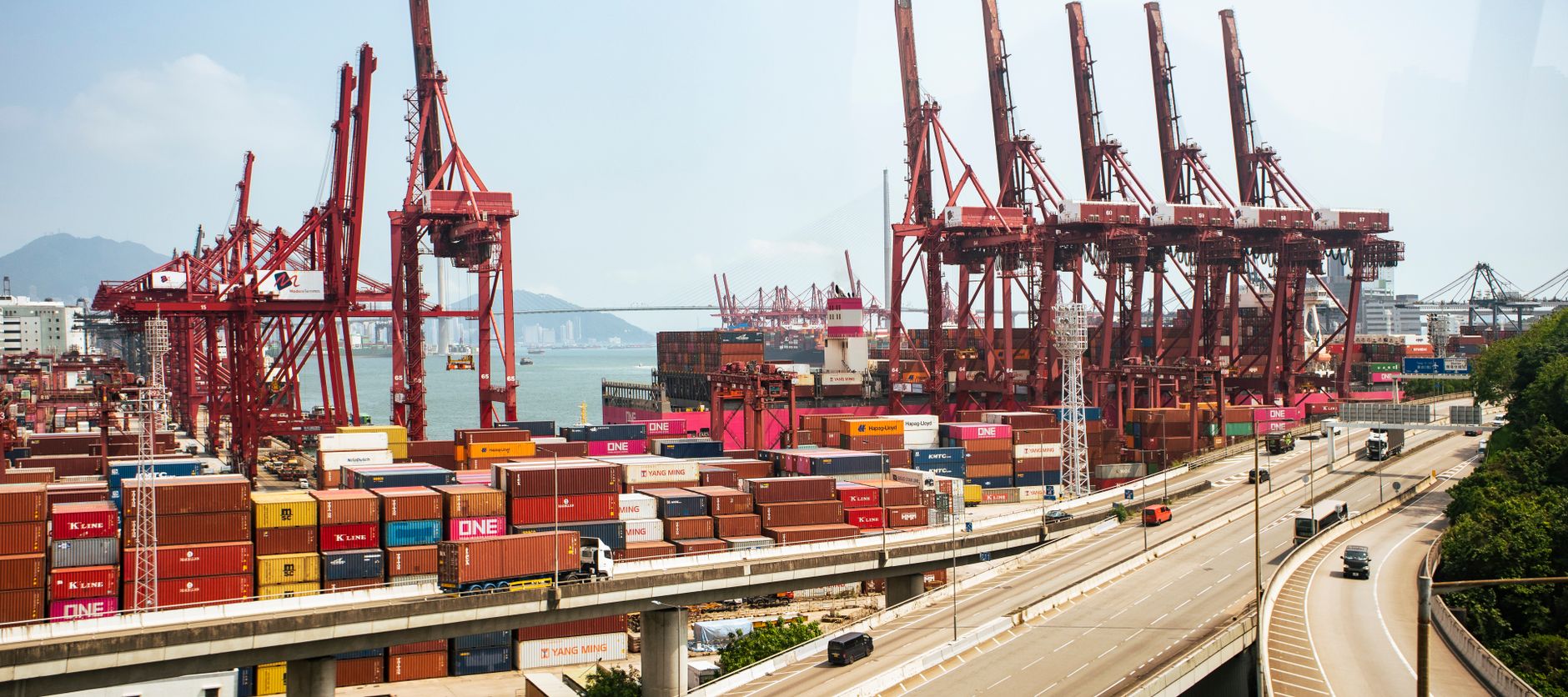
The most tangible commercial impact of the BRI is the transformation of global port infrastructure. China has invested in or operates stakes in over 90 ports worldwide, according to research by the CSIS China Power Project. Strategic nodes include Piraeus in Greece (operated by COSCO Shipping), Hambantota in Sri Lanka, Gwadar in Pakistan, and Djibouti in East Africa.
The strategic logic is straightforward: China is the world’s largest trading nation by volume. Controlling or co-operating key ports reduces logistics costs for Chinese exporters, guarantees berth availability for COSCO and other Chinese carriers, and builds commercial relationships with host governments. For Western importers, several ports that were previously neutral logistics nodes now operate under Chinese commercial management.
The Piraeus Port Authority is the clearest case study. COSCO acquired a 67% stake in the port operator in 2016 for approximately €368 million. Throughput at Piraeus grew from 880,000 TEUs in 2010 to over 5 million TEUs by the early 2020s, making it one of Europe’s fastest-growing container ports. Chinese investment funded new container terminals, cold-chain logistics facilities, and rail connections to Central and Eastern Europe — transforming a secondary Mediterranean port into a primary gateway for Chinese goods entering Europe.
Rail Corridors: The China-Europe Freight Train Network
Perhaps the most underreported BRI development from a trade operations perspective is the dramatic expansion of China-Europe rail freight. The China-Europe Express Train (中欧班列) network now connects over 200 Chinese cities to 25 European countries via routes traversing Kazakhstan, Russia, Belarus, and Poland.
In 2016, approximately 1,700 trains made the journey annually. By 2023, that number exceeded 17,000 trips, carrying goods valued at over $80 billion, according to China State Railway Group data. The transit time — approximately 12 to 15 days compared to 30 to 35 days by sea — positions rail as a premium middle ground between ocean freight and air cargo for time-sensitive industrial goods, automotive components, and electronics.
For Western manufacturers sourcing from China and Chinese exporters targeting European markets, this rail network has created genuine logistics optionality that did not exist a decade ago. The main corridors — through Khorgos on the Kazakhstan border, through Manzhouli into Russia, and via the Trans-Caspian route — each carry distinct transit times, cost profiles, and risk factors depending on geopolitical conditions.
The Digital Silk Road: Infrastructure You Cannot See
Less understood than the physical infrastructure story is the Digital Silk Road — China’s parallel effort to build out undersea fiber optic cables, terrestrial broadband networks, cloud infrastructure, and 5G networks across BRI countries. Huawei and ZTE have deployed telecommunications equipment in over 70 BRI nations. The PEACE Cable — a Chinese-financed undersea cable stretching from Pakistan to East Africa and the Mediterranean — illustrates how the Digital Silk Road is creating new internet routing infrastructure that bypasses traditional systems.
This matters commercially because data routing, latency profiles, and cloud service availability in developing markets are increasingly shaped by Chinese infrastructure decisions. A company launching e-commerce operations in Pakistan, Kenya, or Ethiopia will find that Chinese cloud providers and payment systems carry structural advantages built through years of BRI-aligned investment.
Trade Finance: The BRI’s Less Visible Commercial Architecture
Infrastructure is the visible layer. Trade finance is the structural layer beneath it. The BRI has spawned a parallel financial architecture — the Asian Infrastructure Investment Bank (AIIB), the New Development Bank, and an array of bilateral currency swap agreements — that allows BRI projects to be financed in Chinese yuan rather than US dollars.
As of 2025, the People’s Bank of China has signed currency swap agreements with over 40 central banks. The yuan’s share of global trade settlement has risen to approximately 4.5%, up from near-zero in 2010, according to SWIFT data. While the dollar remains dominant, the BRI’s financial infrastructure is building institutional plumbing for a more multi-polar currency settlement system.
For Western companies bidding on infrastructure projects in BRI countries, this creates a practical challenge: Chinese competitors can often offer more attractive financing terms because they operate within a self-reinforcing ecosystem of Chinese banks, contractors, and currency instruments. Understanding how to position against — or partner within — this financing architecture is a core competency for any serious infrastructure or equipment export business.
What BRI Means for Western Businesses: Four Practical Takeaways
The BRI has concrete commercial implications for anyone operating in international trade:
1. Supply Chain Routing Has Changed
BRI-funded logistics infrastructure across Southeast Asia and Central Asia has improved transit reliability and reduced costs for businesses sourcing from these regions. The US Trade Representative’s office tracks trade flow data useful for benchmarking how these routing changes affect landed costs.
2. Competition in Emerging Markets Has Intensified
Across Africa, Southeast Asia, and Central Asia, Chinese companies now operate with structural advantages: access to state financing, established local relationships built through BRI project execution, and brand recognition from visible infrastructure works. Western companies entering these markets must account for this competitive reality in their market entry plans.
3. Partner Due Diligence Is More Complex
Many local companies in BRI recipient countries have financial or contractual ties to Chinese SOEs or BRI-financed entities. Western compliance teams need to understand BRI financing structures to properly assess counterparty risk, especially in sectors where US sanctions or export control regulations apply. The US Department of Commerce provides guidance on navigating these compliance considerations.
4. Collaboration Opportunities Exist
The BRI is not purely a competitive threat. Western engineering firms, financial advisors, environmental consultants, and technology companies have found commercial opportunities within BRI project ecosystems — providing environmental impact assessment, project management, specialized equipment, and financial structuring services. Understanding the BRI as a market, not just a strategic challenge, opens a different set of business development conversations.
The Road Ahead
The BRI has entered a more selective phase. After a period of aggressive project commitments, China has shifted toward higher-quality, smaller-scale projects with more rigorous financial screening — a response to debt sustainability concerns in recipient countries. The BRI 2.0 emphasizes “small and beautiful” projects, green infrastructure, and digital connectivity over massive, debt-heavy construction programs.
For Western businesses, this evolution matters. A more selective BRI means Chinese infrastructure investment is concentrating in markets where commercial returns are clearest — which are often the same high-growth markets that Western companies are targeting. Strategic competition for influence through infrastructure will intensify in Southeast Asia, the Gulf, and East Africa in the years ahead.
For deeper analysis of related topics, see our coverage of China’s rare earth supply chain, our guide to contract manufacturing at scale, our overview of COSCO Shipping and global maritime trade, and our analysis of China’s high-speed rail revolution.