
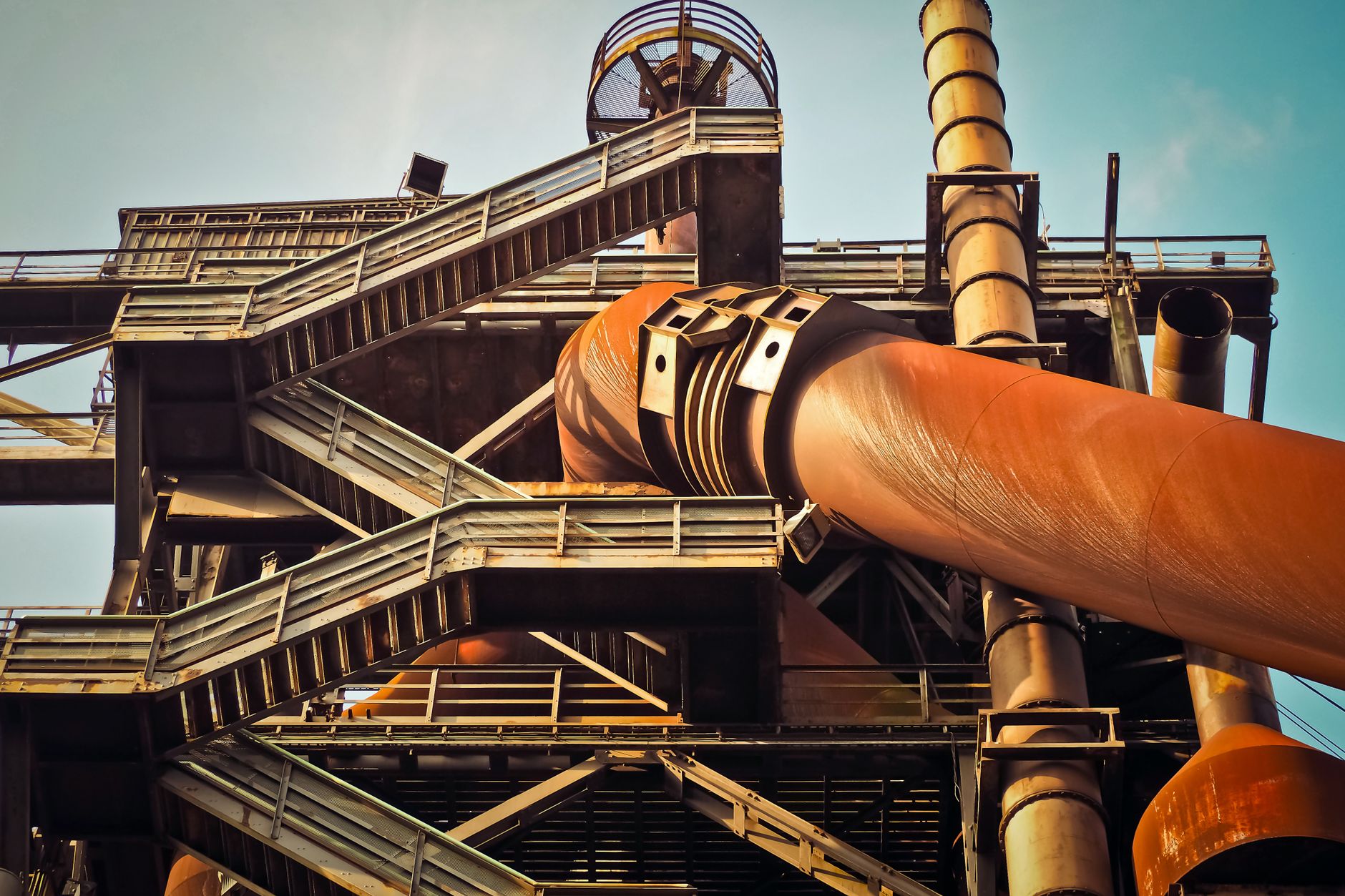
China produces more steel than the rest of the world combined. In 2023, Chinese mills turned out approximately 1.02 billion metric tons – roughly 54% of global output – according to the World Steel Association. China has held this position for more than two decades. For commodity traders, infrastructure developers, construction firms, automotive manufacturers, and anyone whose business touches physical goods, understanding how China’s steel industry works is essential – and not optional.
From Scarcity to Surplus: How China Built Its Steel Colossus
In 1980, China produced roughly 37 million metric tons of steel per year – significant, but not dominant. The country’s rapid industrialization over the next four decades changed everything. By 2000, output had risen to 128 million tons. By 2010, it had crossed 600 million. The growth was relentless, driven by a clear equation: China was building cities, highways, bridges, ports, and factories at a pace the world had never seen.
The Chinese government treated steel as a strategic industry. State-owned enterprises (SOEs) led by China Baowu Steel Group – the world’s largest steelmaker with over 130 million tons of annual capacity – and HBIS Group received preferential land, cheap credit, subsidized energy, and state-backed financing. Private players like Jianlong and Shagang grew alongside them. By the mid-2010s, China was producing more steel than it could consume domestically, and surplus volumes flooded export markets at prices that undercut producers in South Korea, Japan, the United States, and the European Union.
The Global Commodity Market Consequences
Chinese steel production does not just affect Chinese companies – it sets the floor price for steel globally. When China’s domestic demand falters, as it did sharply in 2015 and again during the 2021-2023 property sector collapse, Chinese mills don’t idle capacity; they export. Steel exports surged to 110 million metric tons in 2023, up from 67 million in 2022. That export wave hit Southeast Asia, Africa, the Middle East, and South America hardest, squeezing local producers in Vietnam, Indonesia, and India.
For Western companies, the consequences are twofold. Businesses that buy steel benefit from lower input costs when Chinese exports are abundant. Businesses competing with China-adjacent producers face margin compression as cheap Chinese steel reshapes pricing benchmarks worldwide.
Iron ore and coking coal markets are equally affected. China is the world’s largest buyer of both. Australian miners BHP and Rio Tinto and Brazilian iron ore giant Vale watch Chinese production decisions closely. A cutback in Chinese steel output translates directly into lower ore demand and falling prices – no other country wields this level of commodity market influence.
The US-China Steel Trade Conflict
The United States has been sparring with China over steel for more than a decade. The US Department of Commerce has imposed antidumping and countervailing duties on dozens of Chinese steel product categories, with some duty rates exceeding 500%. The Obama administration’s Section 201 safeguard actions, the Trump administration’s Section 232 tariffs of 25% on all steel imports (which included non-Chinese producers but targeted Chinese overcapacity as the underlying rationale), and the Biden administration’s continuation of those measures all reflect the same diagnosis: Chinese state subsidies distort global steel markets, and domestic producers need protection.
The business reality for importers and manufacturers is nuanced. US steel prices have consistently run above global benchmarks due to tariff protection – sometimes by 30% or more. Companies that source steel domestically from producers like Nucor, US Steel, or Steel Dynamics pay a premium for that security. Companies that need highly specific grades, shapes, or volumes that US mills don’t efficiently produce often seek exemptions or alternative sourcing from tariff-exempt countries like South Korea or Japan, where China’s influence indirectly shapes pricing anyway.
For a broader look at how tariffs have reshaped bilateral trade flows, the US-China Trade in 2026: Tariffs, Restrictions, and What Businesses Need to Know post provides essential context on the current regulatory landscape.
The Carbon Problem That Will Define the Next Decade
Steel production is energy-intensive and heavily carbon-dependent. The dominant method globally – basic oxygen furnace steelmaking using coking coal – emits roughly 1.8 metric tons of CO2 per ton of steel. China’s steel industry accounts for an estimated 15% of China’s total carbon emissions and roughly 8% of global CO2 output.
Beijing has pledged to peak carbon emissions before 2030 and achieve carbon neutrality by 2060. For steel, this means a forced transition toward electric arc furnaces (EAFs), which use scrap steel and emit 70-80% less carbon. China’s EAF share stands at around 10-12% of output – versus roughly 70% in the United States and 40% globally – making the transition challenge immense.
This creates dual opportunities for Western businesses. Companies with expertise in EAF technology, scrap processing, hydrogen-based direct reduction iron (DRI), and industrial decarbonization have a Chinese market actively seeking solutions. Western steel producers who have already made the EAF shift can use their lower carbon intensity as a competitive differentiator. China’s broader green transition is covered in China’s Green Economy: Opportunities in Renewable Energy and ESG.
Consolidation: The End of Fragmentation
For decades, China’s steel industry was notoriously fragmented – thousands of small mills with inconsistent quality, making reliable sourcing difficult. The government has aggressively consolidated the sector. China Baowu alone has absorbed Wuhan Iron and Steel (WISCO), Maanshan Iron and Steel, and others. The goal: concentrate 60% of production in the top 10 producers by 2025, up from roughly 40%.
For foreign companies, consolidation means fewer but larger and more predictable counterparts for technology licensing, joint ventures, and equipment supply contracts. Equipment suppliers like SMS Group, Primetals Technologies, and Danieli have long-established relationships with Chinese mills; consolidation raises the stakes for those long-term contracts.
Practical Implications for US and Western Companies
Whether you are a manufacturer, an investor, an infrastructure developer, or a policy analyst, China’s steel industry touches your world. Here is how to think about it sector by sector:
Construction and Infrastructure
Chinese steel pricing effectively sets global benchmarks for rebar, structural sections, and plates. Western construction companies bidding international projects – in Southeast Asia, Africa, and Latin America – are competing against bids that use Chinese steel at Chinese prices. Understanding the cycle of Chinese overcapacity and export surges allows project planners to time procurement more intelligently.
Automotive and Advanced Manufacturing
High-strength, low-alloy (HSLA) steel and automotive flat-rolled products are segments where Chinese quality has improved significantly. BYD sources most of its steel from Baowu and HBIS domestically. Western automakers sourcing from Chinese suppliers need to understand mill certifications and traceability documentation. China’s evolving supply chain is analyzed in China’s Manufacturing Shift: How Western Companies Should Adapt Their Sourcing and Sales Strategy in 2026.
Technology and Equipment Supply
Chinese steel mills are among the world’s largest buyers of industrial automation, process control systems, refractory materials, and metallurgical equipment. Companies with legitimate competitive advantages in these areas have active market access in China – and the consolidation trend is making procurement cycles more formal and transparent than they once were.
Commodity Trading and Finance
Iron ore futures traded on the Dalian Commodity Exchange (DCE) and steel rebar and hot-rolled coil futures on the Shanghai Futures Exchange (SHFE) are among the world’s most actively traded commodity contracts. Western traders, hedge funds, and industrial companies with physical exposure to steel markets increasingly need to monitor and sometimes participate in Chinese futures markets to hedge effectively.
Looking Ahead: Slower Growth, Higher Stakes
China’s domestic steel demand has likely peaked. The property sector – historically responsible for roughly 25-30% of domestic steel consumption – is contracting structurally as urbanization slows. Infrastructure spending will continue but cannot fully offset that decline, meaning export pressure will persist and potentially intensify as mills maintain capacity utilization by selling abroad.
Price cycles will be shorter and more volatile, driven by Chinese policy responses – capacity cuts, export rebate adjustments, environmental enforcement waves – rather than by steady demand growth. Western businesses with physical steel exposure need more sophisticated hedging strategies than the 2000s boom required. Iron ore futures on the Dalian Commodity Exchange (DCE) and steel contracts on the Shanghai Futures Exchange (SHFE) have become essential tools for anyone with meaningful price risk.
The China steel story is ultimately a case study in what state-directed industrial policy achieves at scale – and in the complex interdependencies that result. Managing those interdependencies, rather than ignoring them, is where the real opportunity lies for Western businesses willing to engage seriously with China’s industrial reality.