
China is the world’s largest producer and processor of food. What is less understood — particularly by Western buyers and trade professionals — is the degree to which China’s processed food industry has matured into a sophisticated, export-oriented machine generating over $70 billion in annual overseas sales. This isn’t a story about cheap noodles or discount seafood. It’s a story about industrial-scale processing, global-standard certifications, deep cold-chain infrastructure, and regional clusters that have made China an indispensable link in global food supply chains.
Understanding where Chinese processed food comes from, who makes it, and how it moves through global trade is no longer optional for food importers, retailers, or procurement professionals.
Three Regional Clusters That Drive China’s Food Processing Exports
China’s processed food export capacity is concentrated in three provincial clusters: Shandong in the northeast, Fujian on the southeast coast, and the Yangtze River Delta provinces of Jiangsu and Zhejiang. Each has distinct product strengths and trade relationships.
Shandong: Seafood, Garlic, and Agricultural Processing at Scale
Shandong Province is China’s single largest agricultural province by output value, contributing roughly 8.5% of the country’s agricultural GDP. Its seafood processing complex — centered on Qingdao, Rizhao, and Weihai — processes and exports more seafood by value than any other Chinese province. Companies such as Zoneco Group (獐子岛集团), listed on the Shenzhen Stock Exchange, operate vertically integrated operations from ocean farm to finished product. Shandong’s seafood exports exceeded $4.5 billion in a recent year according to provincial trade data.
Beyond seafood, Shandong is the world’s undisputed garlic processing capital. Jinxiang County alone accounts for an estimated 70% of global garlic trade, supplying dehydrated garlic, garlic powder, and garlic oil to food manufacturers across North America, Europe, and the Middle East. Luhua Group, one of China’s largest peanut oil producers with annual crushing capacity exceeding 2 million tons, exports refined oils and peanut products to over 30 countries.
Fujian: Tea, Aquaculture, and the Southeast Asian Diaspora Network
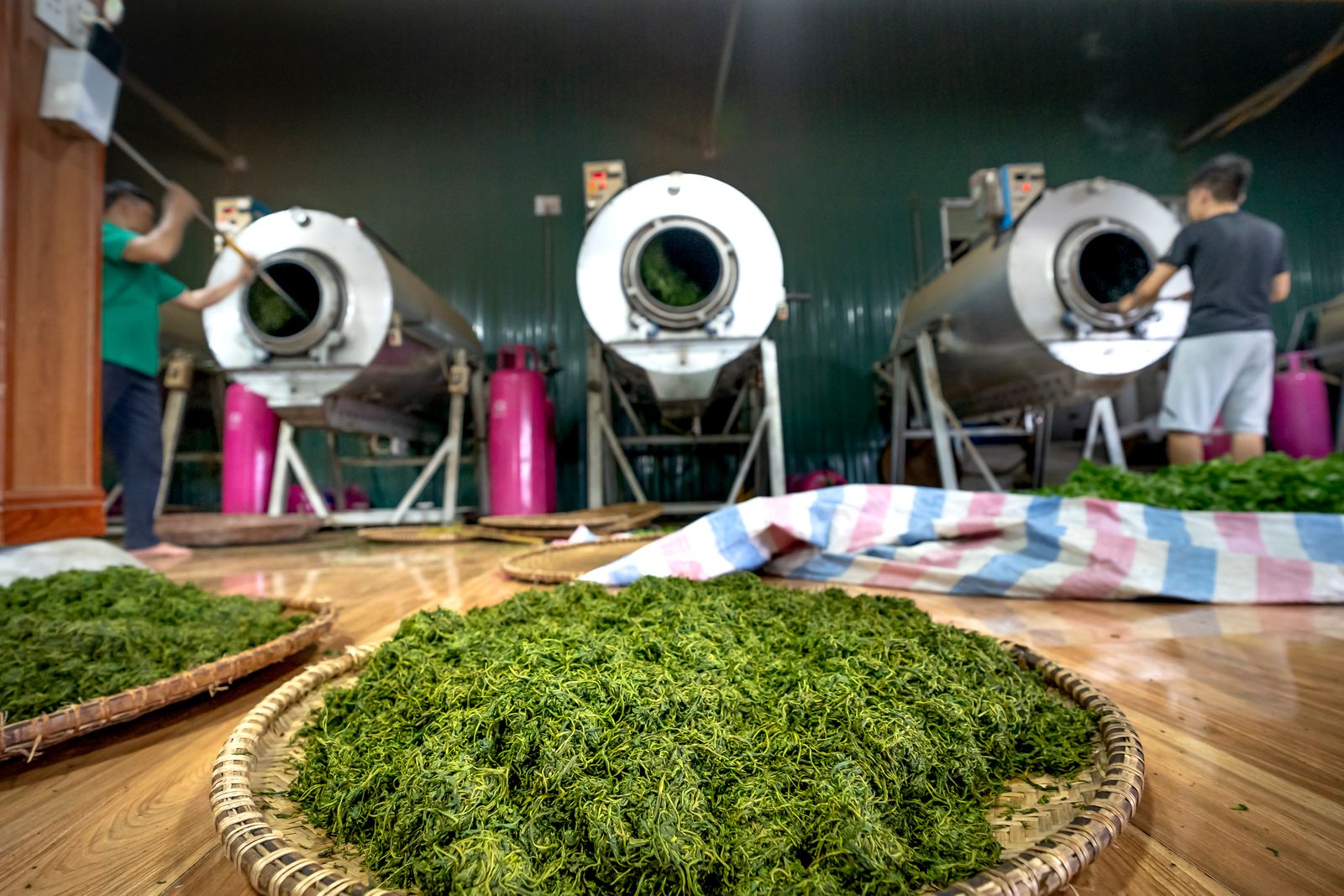
Fujian Province is China’s largest tea exporter by value, anchored by oolong and white tea production in Anxi, Wuyi, and Fuding. Local processors have invested heavily in EU-compliant pesticide residue testing and ISO 22000 certifications to access premium European markets. Fujian’s aquaculture processing industry — centered on Fuzhou, Zhangzhou, and Ningde — supplies processed eel products to Japan and canned vegetables and seafood to private-label buyers across Southeast Asia and the Middle East.
The Yangtze Delta: High-Value Processing and Logistics Integration
Jiangsu and Zhejiang together form the highest-value, most logistics-integrated food processing corridor in China. As documented in our analysis of Jiangsu Province’s industrial export engine, the delta benefits from proximity to Shanghai and Ningbo-Zhoushan — two of the world’s top five container ports. Zhejiang exports specialty dried foods including Jinhua ham (China’s famous cured pork, analogous to Prosciutto di Parma) and packaged snacks. Jiangsu’s Haitian Flavouring and Food Co. (海天味业), with revenues exceeding RMB 26 billion in 2023, has expanded exports of soy sauce and condiments to North American foodservice operators and diaspora retail channels.
What Makes China’s Processing Sector Globally Competitive
Four structural advantages sustain China’s edge in processed food exports.
Raw material aggregation at unmatched scale. A garlic processor in Jinxiang can access 2 million tons of fresh garlic within 200 kilometers during peak harvest. No Western processor operates in a comparable raw material environment for that product category.
Processing cost economics. While Shandong manufacturing wages reached approximately RMB 6,200 per month in 2024, the combination of scale, automation investment, and vertical integration keeps per-unit costs below most alternative origins.
Certification infrastructure. China’s General Administration of Customs (GACC) maintains a registered facilities database covering approximately 20,000 export-eligible food processing plants. US FDA Foreign Supplier Verification Program (FSVP) requirements have pushed Chinese exporters to invest in HACCP, SQF Level 2, and BRC Global Standard certifications. Compliance rates among exporters targeting Tier 1 North American retailers are now meaningfully higher than a decade ago.
State support and infrastructure investment. The central government’s designation of agricultural processing as a priority under the 14th Five-Year Plan triggered investment in cold-chain logistics, rural road networks, and processing parks. As detailed in our coverage of COFCO’s role in global agricultural markets, China’s leading state-owned food conglomerates have benefited from policy-directed financing for export-oriented operations.
The US-China Processed Food Trade Relationship
The United States is one of China’s top five export markets for processed food. According to the US International Trade Commission (USITC), processed food imports from China — including seafood, garlic preparations, preserved vegetables, condiments, and packaged snacks — represent a multi-billion-dollar annual trade flow.
The relationship is genuinely bilateral. The US exports significant volumes of pork products, California tree nuts, poultry, and distillers dried grains (DDGS) to China. The Phase One Trade Agreement signed in January 2020 included specific Chinese commitments to expand US agricultural purchases. As analyzed in our review of China’s agri-food export ecosystem, the structural trade relationship in food and agriculture remains commercially significant for both sides despite policy-level friction.
For compliance context: China’s GACC registration requirements, tightened in 2021, mean that any food product exported from China must originate from a registered facility. Western buyers can verify status through the GACC’s online database. The USDA Foreign Agricultural Service publishes detailed market intelligence on Chinese food exports that remains essential reading for supply chain teams. The USDA FAS China page tracks commodity trade flows, tariff impacts, and market access conditions on an ongoing basis.
A Sourcing Framework for Western Food Buyers
For food importers, private-label retailers, and foodservice procurement teams, matching sourcing strategy to China’s regional specialization is the foundation of an effective supply chain approach. The contrast between Guangdong’s manufacturing ecosystem and Zhejiang’s entrepreneurial export culture — analyzed in our piece on Guangdong vs. Zhejiang as sourcing hubs — applies directly to food processing: different regions have different strengths.
Seafood: Shandong and Fujian are the strongest origins for most marine and farmed freshwater species. Prioritize GACC-registered, HACCP-certified suppliers. Tilapia from Guangdong and Hainan is a major category for North American retail.
Dried and preserved foods: Zhejiang and Fujian lead. Specialty tea, dried shiitake mushrooms, and preserved vegetables represent a growing premium export segment.
Condiments and sauces: Guangdong and Shandong dominate. Haitian, Lee Kum Kee, and Shinho are the dominant branded suppliers; thousands of smaller OEM manufacturers supply private-label globally.
Garlic, ginger, and processed aromatics: Shandong is unambiguously the global leader. US Section 301 tariffs affect processed garlic imports — buyers should model the landed cost impact at current duty rates.
The Road Ahead: Consolidation and Premiumization
China’s processed food export sector is consolidating. The government’s National Rural Revitalization Strategy is accelerating the shift toward fewer, larger, better-capitalized processors with stronger compliance infrastructure and greater export ambition. Companies like Want Want Holdings — generating approximately $2.2 billion in annual revenue from packaged snacks and dairy beverages — are demonstrating that Chinese food brands can achieve mainstream retail distribution beyond diaspora channels.
For Western buyers, consolidation means a better-qualified supplier base and more sophisticated commercial partners. For Western food brands, it means more capable Chinese co-manufacturers able to produce to international specifications at competitive cost. The processed food sector may lack the headline drama of electric vehicles or semiconductors, but for the day-to-day operations of global food supply chains, it remains one of the most consequential bilateral trade relationships in the world. Understanding it clearly — its geography, its players, its compliance architecture — is the starting point for any serious US-China commercial food strategy.