
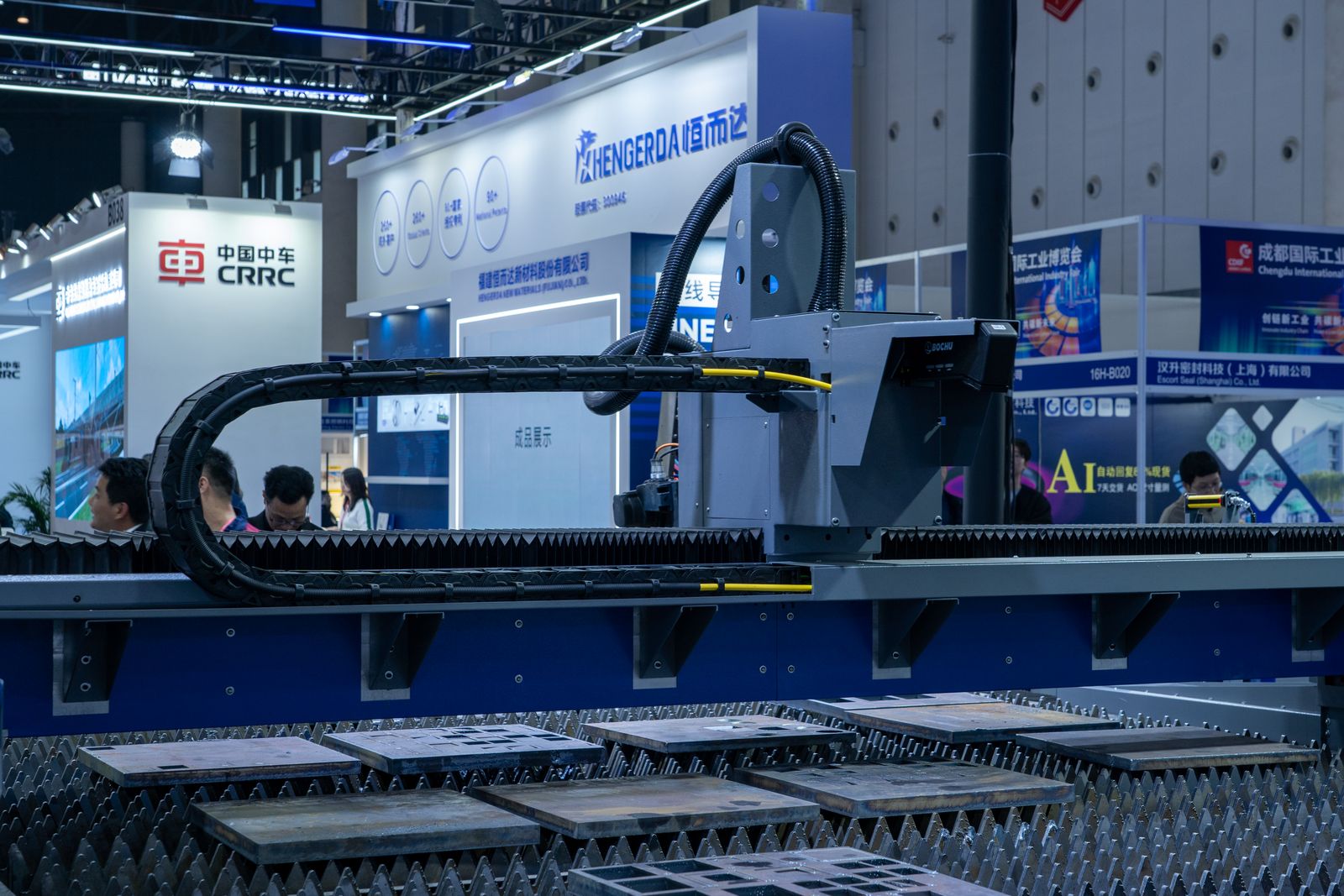
Walk through any major factory in Guangdong, Suzhou, or Chongqing today and you will find something that did not exist a decade ago: collaborative robots, AI-driven quality inspection cameras, digital twin dashboards, and 5G-connected assembly lines that communicate in real time. China’s smart manufacturing revolution is not a government slogan. It is a measurable transformation that is directly altering the competitive calculus for every global supply chain professional and multinational manufacturer operating in or sourcing from China.
The Policy Foundation: MIIT’s Smart Manufacturing Push
China’s Ministry of Industry and Information Technology (MIIT) formally launched its Smart Manufacturing Development Plan (2021-2025) as a cornerstone of the 14th Five-Year Plan. The strategy targeted 30,000 factories transformed into “digital workshops” and 2,000 into certified “smart factories” by 2025. By mid-2026, official MIIT figures indicate over 12,000 benchmark smart factories recognized at national or provincial level, with spending on industrial automation exceeding 1.2 trillion RMB (approximately $165 billion USD) since 2021.
Three pressures drive the urgency: rising wages (manufacturing pay in coastal cities has roughly tripled since 2010), a shrinking labor pool, and competition from Vietnam, India, and Mexico. The MIIT Smart Manufacturing Development Plan outlines specific targets for robotics density, industrial internet platform adoption, and digital twin deployment across 10 priority sectors including automotive, electronics, and chemicals.
The Industrial Robot Surge: From Buyer to Builder
China was already the world’s largest buyer of industrial robots for a decade before it became a major producer. In 2023, China installed approximately 276,000 industrial robots — more than the rest of the world combined, according to the International Federation of Robotics (IFR). The more consequential shift: China is now manufacturing those robots domestically at scale.
ESTUN Automation (埃斯顿), headquartered in Nanjing, posted revenues exceeding 4 billion RMB in 2023 with a growing export footprint across Southeast Asia and Europe. SIASUN Robot and Automation, based in Shenyang, focuses on heavy industrial applications including automotive welding. Han’s Robot, a division of Han’s Laser Technology, has deployed thousands of collaborative robots (cobots) across electronics, food processing, and pharmaceutical factories.
As detailed in our analysis of China’s Robotics Industry: How Han’s Laser, ESTUN, and SIASUN Are Building the Automation Backbone of Global Manufacturing, domestic robot prices have fallen 40 to 60 percent over the past five years as Chinese producers achieve scale. This price compression now enables small and medium-sized manufacturers to automate processes that previously required full human assembly lines.
Haier COSMOPlat: The Industrial Internet Platform Setting the Global Standard
No company better illustrates China’s smart manufacturing ambition than Haier’s COSMOPlat — an IIoT and mass customization platform now managing over 4,000 factories across 15 industries. A consumer customizes a product online; that data flows instantly to the factory, adjusting the production sequence in real time. Haier reports COSMOPlat reduces product development cycles by 50 percent and improves order fulfillment efficiency by 28 percent. By 2025, the platform had been licensed in over 20 countries including Germany, the United States, and Japan.
The World Economic Forum has recognized six Haier factories as “Lighthouse Factories” — the global smart manufacturing benchmark — more than any other company in the world. For Western buyers, this signals that your Chinese supplier may now be a technology-enabled production partner with proprietary digital infrastructure, not simply a contract manufacturer.
XCMG, Sany, and Smart Heavy Equipment
China’s heavy construction equipment sector offers a compelling case study. Sany Heavy Industry’s Lighthouse Factory in Beijing integrates 5G connectivity, AI weld inspection, and digital twin simulation to manage over 100 excavator models on a single line — cutting defect rates by 60 percent and delivery lead times by 45 percent. Sany’s annual revenue reached approximately $14 billion in 2023, with exports exceeding 40 percent of sales.
XCMG, the world’s third-largest construction machinery manufacturer, invested over 1 billion RMB in its Xuzhou smart factory campus. Its XMC intelligent manufacturing system processes data from over 200,000 pieces of operating equipment globally, generating predictive maintenance revenue from customers in 190 countries. These companies are no longer competing solely on price — they compete on data-driven services and integrated digital platforms that directly challenge Caterpillar and Komatsu.
The Automotive Supply Chain: Precision at Scale
Nowhere is smart manufacturing integration more consequential than in China’s automotive supply chain, particularly as EV production accelerates. As examined in our profile of China’s Tier-1 Automotive Parts Suppliers, Chinese suppliers have moved aggressively from low-cost stamping to precision electronics, battery management systems, and sensor arrays.
CATL’s gigafactories track every cell from raw material input through formation and pack assembly using proprietary MES technology. Reported yield rates exceed 99.5 percent — rivaling Samsung SDI and LG Energy Solution’s best-performing plants. BYD’s vertical integration model is even more striking: the company manufactures its own semiconductor chips, battery cells, motors, and power electronics in-house, with smart factory integration connecting every link of that chain.
For global OEMs and Tier-1 suppliers evaluating sourcing strategies, this combination of vertical integration and digital manufacturing capability represents a competitive shift that pricing negotiations alone cannot address.
Midea’s Robotics Pivot and the Appliance-to-Industrial Playbook
Midea’s 2016 acquisition of KUKA — the German industrial robotics giant — for $4.7 billion was never purely an appliances play. As explored in our analysis of Midea’s Global Technology Strategy, KUKA gave Midea world-class robotics technology to automate its own factories globally and build a B2B automation business now generating over $2 billion annually from external clients.
This trajectory — from product manufacturer to manufacturing technology provider — is repeated by Foxconn (40,000+ proprietary Foxbots deployed in Chinese factories), Sany, and XCMG. China’s most sophisticated manufacturers are now exporting smart manufacturing know-how to facilities in Mexico, India, and Eastern Europe, carrying competitive advantage built in China directly into global operations serving Western brands.
Shenzhen’s Role: Hardware Ecosystem Meets Digital Intelligence
Any analysis of China’s smart manufacturing story returns to Shenzhen. As documented in our in-depth profile of Shenzhen: The World’s Factory That Became a Global Innovation Hub, the Pearl River Delta city has evolved into an integrated hardware-software ecosystem unmatched anywhere on earth.
A factory launching a new smart manufacturing project in Shenzhen can source sensors, controllers, custom PCBs, MES software, and systems integration services within a 50-kilometer radius. Iteration cycles that take months in Europe or North America complete in weeks in Shenzhen. This geographic concentration of manufacturing intelligence is itself a form of structural competitive advantage — one that no reshoring initiative can easily replicate by simply relocating assembly.
What This Means for Western Businesses
China’s smart manufacturing revolution creates concrete operational implications for any business that sources from or competes with Chinese manufacturers:
Supplier audits must now include digital capability assessments. A factory’s MES maturity, defect tracking systems, and real-time data visibility now matter alongside ISO certifications. Smart factories have yield, defect, and OEE data immediately available. Buyers should ask for it.
Lead times and minimum order quantities are changing. Flexible smart manufacturing lines accommodate smaller batches and faster customization cycles. Sourcing terms negotiated five years ago may no longer reflect what your supplier is actually capable of delivering.
China’s manufacturers are competing on value, not just price. The era of pure labor-cost arbitrage is narrowing. The sustainable Chinese manufacturing advantage now lies in speed, precision, digital integration, and vertical supply chain control. Procurement strategies should reflect this reality.
Smart manufacturing capability is a partnership signal. Suppliers who have invested in digital infrastructure, custom tooling, and process integration for your products carry higher switching costs and stronger incentives to maintain quality. Long-term strategic supplier relationships in China now carry more measurable value than pure-price vendor relationships.
For US businesses evaluating competitive positioning, the US International Trade Administration’s Advanced Manufacturing Market Overview provides useful context on how American manufacturers and technology firms are partnering with Chinese counterparts — and where the bilateral opportunity remains strongest.
China’s smart manufacturing revolution is not a competitive threat to be managed from a distance. It is the operational reality of the global supply chain in 2026. The businesses that understand it — and build sourcing and partnership strategies that reflect it — will have a durable edge over those that don’t.