
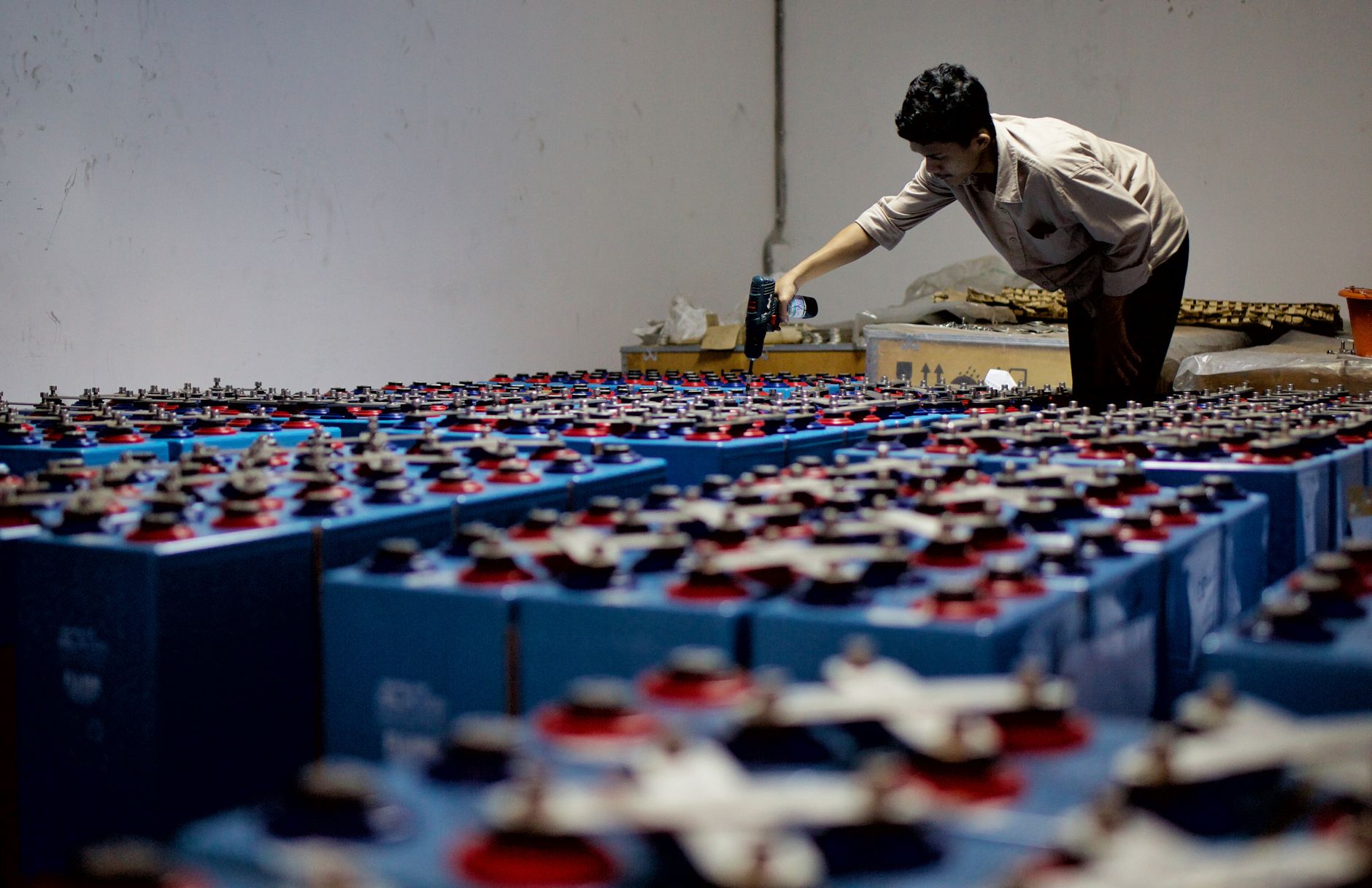
In July 2021, CATL founder Robin Zeng unveiled a commercially viable sodium-ion battery cell — 160 Wh/kg energy density, zero-lithium chemistry, and a production timeline already in motion. The announcement landed like a recalibration signal for an industry that had bet its entire supply chain on lithium. In 2026, that signal has become a ramp. CATL’s sodium-ion program is now in commercial production, shipping packs for entry-level EVs and stationary grid storage across China. The implications reach well beyond one company — they rewrite assumptions about raw material dependencies, global commodity markets, and the competitive dynamics of clean energy supply chains.
Why Sodium-Ion? The Supply Chain Logic
CATL’s sodium-ion push is fundamentally a supply chain strategy. The company manufactures over 400 GWh of lithium-ion cells annually, and that scale makes it acutely sensitive to lithium price volatility. Lithium carbonate prices swung from $17,000 per metric ton in early 2021 to over $80,000 by late 2022 before collapsing below $14,000 in 2024. That range — nearly 5x from trough to peak — is not a market anomaly. It is structural, driven by the concentration of lithium mining in Australia, Chile, and Argentina against Chinese processing dominance that creates price transmission gaps.
Sodium-ion chemistry eliminates lithium entirely. The cathode uses Prussian white or layered oxide compounds; the anode uses hard carbon derived from biomass. Sodium is the sixth most abundant element on Earth with no geographic concentration risk. CATL’s own modelling suggests sodium-ion cells can be manufactured at 10-15% below equivalent LFP cells at scale — a structural margin advantage that compounds across hundreds of gigawatt-hours of annual production.
The tradeoffs are real but manageable. Current sodium-ion cells carry lower energy density (160-200 Wh/kg versus 250+ Wh/kg for premium LFP). They charge faster in cold temperatures and present reduced thermal runaway risk. For short-range urban EVs, two-wheelers, and grid storage where cost and safety matter more than range, the economics are already compelling.
The AB Architecture: Bridging Two Chemistries
Rather than forcing a binary chemistry choice, CATL developed the AB battery pack system — a modular architecture combining sodium-ion (A cells) and lithium-ion (B cells) within a single pack. The battery management system allocates load between chemistries in real time, with sodium cells handling lower-power thermally stable functions and lithium cells managing peak demands.
Chery Automobile was the first automaker to commit to a vehicle built on CATL’s AB architecture, targeting the affordable segment under 100,000 RMB (approximately $13,800). BYD announced its own parallel sodium-ion program, though production timelines lag CATL’s. The competitive dynamic within China ensures commercialization will accelerate faster than any single-player market would allow — domestic battery price competition historically compresses costs 15-25% within 24 months of commercial launch.
Grid Storage: The Larger Prize
Electric vehicles generate the headlines, but stationary grid storage may be the more consequential sodium-ion market. China’s National Development and Reform Commission (NDRC) mandates that new renewable installations pair with 10-20% capacity in battery storage — a policy that creates hundreds of gigawatt-hours of annual demand that is purely cost-sensitive. Grid operators buy cycling capacity at the lowest sustainable cost per kilowatt-hour, not range or brand. Sodium-ion is purpose-built for that procurement logic.
CATL’s Ningde gigafactory complex in Fujian Province — the world’s largest single battery manufacturing campus — now runs dedicated sodium-ion production lines. A second sodium-ion-capable facility is under development in Sichuan Province, targeting western China’s hydropower and solar storage corridor.
Implications for Lithium Markets and US-China Trade
Sodium-ion at scale directly pressures lithium demand forecasts that underpinned billions in mining investment between 2020 and 2024. If sodium-ion captures 20-30% of Chinese battery production by 2028, the structural ceiling for lithium demand shifts meaningfully lower. American lithium producers including Albemarle and Arcadium Lithium built expansion plans on a supercycle thesis that sodium-ion complicates.
The US Department of Energy’s Loan Programs Office has financed multiple domestic lithium and battery supply chain projects assuming sustained demand growth — those project economics deserve revisiting. The DOE’s Vehicle Technologies Office has funded sodium-ion R&D through ARPA-E and the Battery500 Consortium, but US commercial production capabilities remain years behind CATL’s current deployment pace. Argonne National Laboratory and Stanford researchers have contributed foundational academic work; the gap is in manufacturing scale-up infrastructure, not fundamental chemistry knowledge.
European automakers including Volkswagen and Renault are reportedly in advanced procurement discussions with CATL for sodium-ion cells in small-format EVs — a segment where LFP has been less cost-competitive. If those agreements close, CATL will have used sodium-ion to extend market share into vehicle categories that Samsung SDI, LG Energy Solution, and Panasonic currently serve, none of which have sodium-ion programs past pilot phase.
The Hard Carbon Supply Chain
Sodium-ion batteries require hard carbon anodes synthesized from biomass — wood, coconut shells, agricultural residue. China’s position in hard carbon supply is building into a structural advantage analogous to its lithium processing dominance. Shanshan Co., BTR New Material Group, and Kureha China are scaling hard carbon capacity for sodium-ion demand, drawing on biomass feedstocks from rice and bamboo agriculture concentrated in Hunan, Sichuan, and Jiangxi provinces.
This is not a rare earth monopoly situation — sodium is globally abundant — but the processing and anode manufacturing concentration is worth tracking. For broader context on how China builds structural material advantages that shape trade, see our analysis of China’s rare earth strategy and how Ganfeng and Tianqi control global lithium supply.
Competitors and the Global Race
CATL’s domestic competition includes HiNa Battery Technology — spun out of the Chinese Academy of Sciences — which has been commercializing sodium-ion since 2023 for grid projects in Shanxi and Inner Mongolia. SVOLT Energy (Great Wall Motor) has development commitments. Outside China, Faradion (acquired by Reliance Industries in 2022) is the most advanced Western developer; Natron Energy targets data center UPS applications. Neither can compete with CATL on volume or cost within the current decade.
For a full picture of how CATL’s gigafactory strategy in Hungary and Morocco localizes production while retaining technology control, see our coverage of CATL’s overseas gigafactory push. CATL’s investor disclosures are published on the Shenzhen Stock Exchange portal under ticker 300750.
What Business and Trade Professionals Must Act On
For companies in energy, automotive supply chains, or clean technology trade, three questions demand immediate attention. First: are your lithium supply agreements or project stakes stress-tested against sodium-ion capturing 20-25% of Chinese battery production by 2028? If not, the economics deserve a scenario review. Second: does your EV procurement evaluation include sodium-ion cell specifications? CATL’s AB architecture allows cost optimization without a full platform retool — it is not an all-or-nothing technology switch. Third: have you assessed tariff and IRA classification treatment for sodium-ion cells entering the United States? Section 301 schedules and domestic content rules were written around lithium-ion chemistry; sodium-ion may create classification ambiguity requiring advance CBP rulings before import volumes scale.
For investors, the battery recycling infrastructure that China built around lithium-ion will need to be rebuilt for sodium-ion — creating transition risk for established recyclers and new opportunity in hard carbon recovery chemistry.
CATL’s sodium-ion program is not a pivot away from lithium. It is a calculated portfolio expansion into cost-sensitive segments where no current lithium chemistry can match the economics. The disruption is already in production. The only question is how fast Western supply chains respond before the cost gap becomes a permanent competitive disadvantage.