
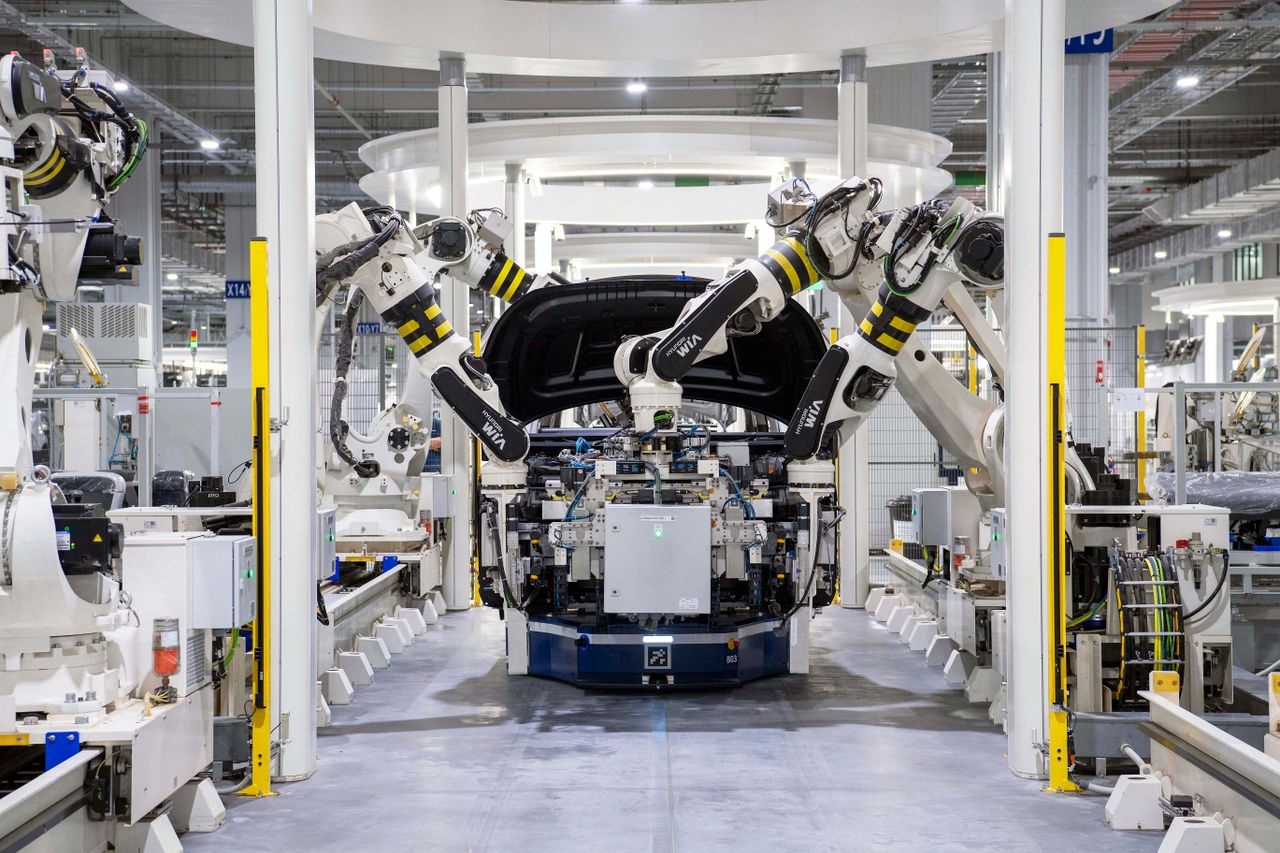
When Contemporary Amperex Technology Co. Limited broke ground on its first European gigafactory in Erfurt, Germany in 2019, the move went largely unnoticed outside the automotive industry. By 2026, that decision looks prescient: the Thuringia facility is now one of CATL’s highest-output production sites outside China, and a template the company is replicating across three continents. CATL’s overseas manufacturing expansion is no longer a hedge against trade risk. It is a core strategic pillar.
For procurement executives at Western automakers, policy analysts tracking the energy transition, and any business operating somewhere along the EV supply chain, understanding CATL’s localization strategy is now a matter of commercial necessity.
From Exporter to Local Manufacturer
CATL was founded in 2011 in Ningde, Fujian Province, by Robin Zeng Yuqun, a former senior engineer at ATL. The company’s ascent to global battery dominance has been well documented. By 2025, CATL held approximately 34-36% of global EV battery market share — still more than its next four competitors combined.
The early strategy was straightforward: manufacture in China, ship to the world. That model worked as long as tariffs were manageable and geopolitical risk was theoretical. Neither condition holds in 2026.
The EU’s provisional tariffs on Chinese-made EVs, combined with the US Inflation Reduction Act’s domestic content requirements, have made local battery production a commercial requirement for automakers seeking to qualify for subsidies and avoid import duties. CATL read the room early. Its response was not to lobby against these measures but to build around them.
The European Blueprint: Erfurt and Hungary
CATL’s Erfurt gigafactory has a planned annual capacity of 14 GWh, with ambitions to reach 60 GWh over successive phases. Customers serviced from the site include BMW, Volkswagen, and Stellantis-group brands. The plant employs roughly 2,500 people locally — a deliberate signal to regulators and local politicians.
In 2022, CATL announced its second European manufacturing site: a 100 GWh gigafactory in Debrecen, Hungary, representing an investment of approximately €7.3 billion. The choice was strategic. Hungary offers favorable corporate tax rates, a skilled manufacturing workforce, proximity to German and Slovak automaker assembly lines, and a government willing to negotiate aggressively on incentives. Mercedes-Benz and BMW are among the confirmed offtake customers. The Debrecen facility’s positioning within a day’s drive of seven major European automaker assembly plants was not accidental.
North America: The Ford Deal and the Political Minefield
CATL’s North American ambitions have been more complicated. In early 2023, the company announced a licensing agreement with Ford Motor Company: Ford would build and operate a $3.5 billion battery plant in Marshall, Michigan, using CATL’s lithium iron phosphate (LFP) technology under a licensing arrangement. Ford would own and operate the facility; CATL would provide technical support and IP access.
The structure was deliberately designed to satisfy the IRA’s domestic content requirements while allowing CATL to avoid the political exposure of building a Chinese-owned factory on American soil. Congressional scrutiny forced Ford to pause and restructure the deal, and by 2025 a modified version moved forward under enhanced oversight conditions.
The Michigan episode illustrates the central challenge of CATL’s US strategy: the technology is indispensable to American automakers’ EV transition goals, but direct Chinese ownership of critical battery manufacturing faces legislative and national security headwinds that cannot be resolved purely through commercial negotiation. CATL’s response has been to pursue IP licensing, joint ventures, and minority-stake structures that keep its technology in the market without triggering the most restrictive ownership thresholds. As we covered in our analysis of China’s evolution from trophy acquisitions to strategic partnerships, this licensing-forward approach is becoming the dominant model for Chinese technology leaders in sensitive sectors.
Indonesia: Securing the Raw Material Supply Chain
CATL’s overseas expansion extends upstream. Through subsidiaries and consortium arrangements, CATL has committed billions of dollars to Indonesian nickel processing projects, partnering with local state-owned enterprises and building integrated battery manufacturing facilities on Indonesian soil. Indonesia holds the world’s largest proven nickel reserves — a critical input for high-energy-density NCM batteries. Jakarta’s export ban on raw nickel ore, designed to force downstream processing investment into the country, has accelerated this dynamic. CATL’s willingness to invest in local processing capacity made it a preferred partner in Jakarta.
This upstream positioning is part of a broader raw material security strategy spanning lithium operations in Australia, Chile, Bolivia, and the DRC. Our analysis of China’s lithium supply chain dominance provides the essential background for understanding how CATL’s battery manufacturing ambitions are anchored in raw material control that begins well before any cell is produced.
Technology Portfolio and Chemistry Strategy
CATL’s localization strategy is also a technology positioning exercise. Its product portfolio spans multiple battery chemistries. LFP batteries — cheaper, longer-cycling, and safer but lower in energy density — dominate standard-range EV and commercial applications. The Qilin battery, an NCM cell-to-pack design with claimed energy densities exceeding 255 Wh/kg, targets premium segments and grid storage. The company has also begun commercial production of sodium-ion batteries, which use no lithium and no cobalt, positioning CATL to serve markets where raw material cost sensitivity is paramount.
The strategic advantage of maintaining scale across all three chemistries simultaneously — something no Western competitor has yet replicated — gives CATL negotiating flexibility and product fit across a range of applications and price points. For procurement teams building battery sourcing strategies, this depth of portfolio is a meaningful differentiating factor.
Competitive Context and What It Means for Western Businesses
CATL is not operating in isolation. BYD, which produces cells primarily for its own vehicles but increasingly supplies third parties, is pursuing its own European manufacturing investments. Korean competitors LG Energy Solution and Samsung SDI are investing heavily in US manufacturing to capture IRA-driven demand. The competitive dynamics between CATL, BYD, and CALB continue to evolve, creating new leverage points for Western buyers. BYD’s own global expansion trajectory is running in parallel, further intensifying competition at the gigafactory level.
The net effect is a rapid and permanent restructuring of the global battery manufacturing map. The era of centralized production in China serving global demand through exports is giving way to a distributed model in which major producers maintain manufacturing presence in each key consuming market. CATL is leading that transition on the Chinese side.
For Western policy makers, local battery manufacturing creates energy security. The persistent challenge is that the intellectual property underpinning much of that local production still flows substantially from Chinese companies — a form of technology dependency that persists even when the assembly line sits in Thuringia or Tennessee. The rare earth and critical mineral export control dynamics running alongside these manufacturing decisions add further strategic complexity.
Practical Takeaways for Trade and Investment Professionals
Several conclusions are worth anchoring. Chinese industrial companies with genuine technological leads are adapting to protectionist policy environments by localizing — not retreating. IP licensing and joint venture structures are the preferred mechanism for market access when direct ownership faces regulatory barriers. Raw material security is inseparable from finished goods manufacturing strategy; CATL’s upstream investments are as strategically important as its cell factories. And local manufacturing creates local stakeholders — employers, taxpayers, supply chain partners — who have a direct commercial interest in bilateral trade relationships remaining functional.
That last point matters for the long-term trajectory of US-China and Europe-China economic relations. CATL’s European gigafactories create German and Hungarian jobs, pay European taxes, and supply European automakers with components they currently have no domestic alternative for. That is not politics. That is the architecture of interdependence — and it is exactly the kind of durable commercial relationship that survives geopolitical friction because both sides have too much to lose from its collapse. The U.S. Department of Commerce’s clean energy industry resources document the American policy framework governing foreign battery manufacturing investments and the supply chain compliance requirements that companies like CATL must navigate in US-adjacent markets.
Official data on battery investment and manufacturing incentives: see the US Department of Energy Loan Programs Office vehicle manufacturing resources and the China Ministry of Industry and Information Technology automotive industry division, which publishes regular data on domestic and overseas EV battery production capacity.