
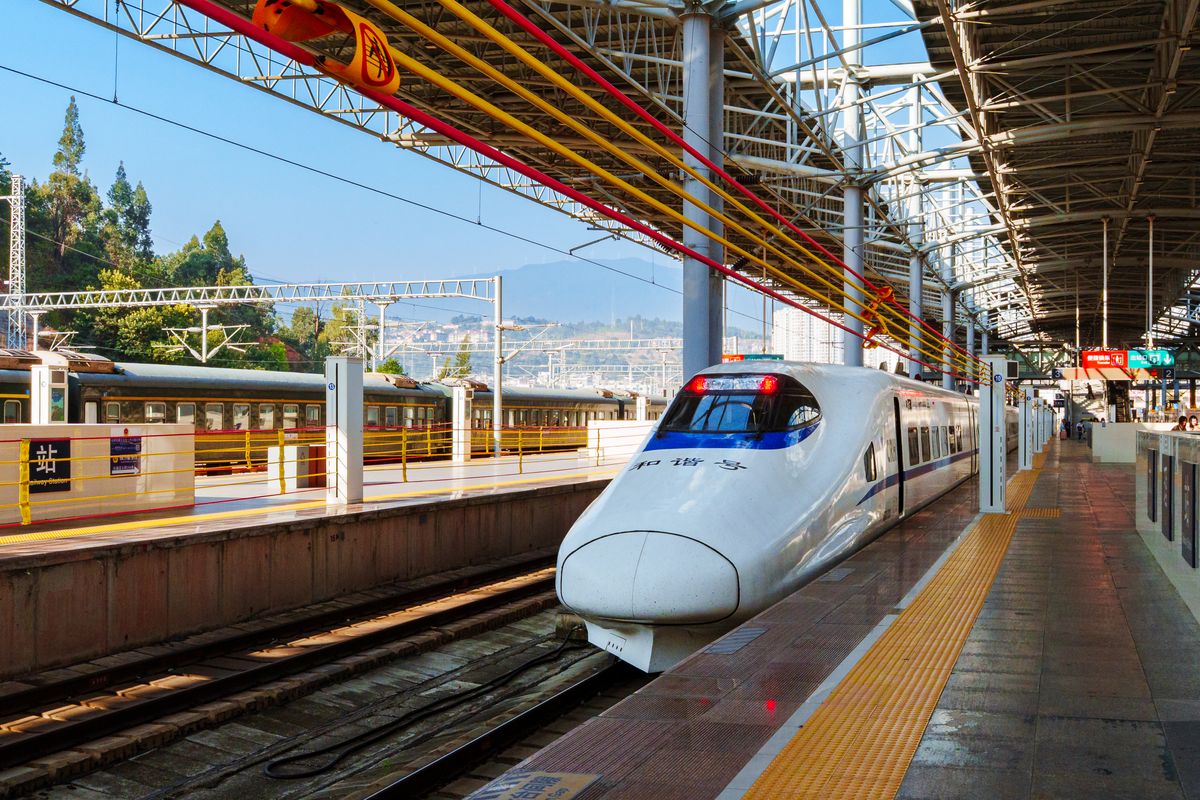
In 1978, China had zero kilometers of high-speed rail. Today it operates more than 46,000 kilometers — roughly two-thirds of the entire world’s HSR network — and is building more. The system carries over 3.8 billion passengers per year, moves freight across 160 cities, and has reshaped regional economies from Chengdu to Xiamen in ways that urban planners and infrastructure investors still struggle to fully quantify.
But the most underappreciated story about China’s high-speed rail revolution isn’t the scale — it’s the financing model, the industrial policy behind it, and the lessons it offers for anyone trying to understand how large-scale national infrastructure projects actually get built. For US and Western businesses, understanding how China financed, built, and is now exporting its HSR expertise is essential context for navigating bilateral trade, supply chain decisions, and infrastructure investment strategy.
From Zero to 46,000 Kilometers: The Speed of Execution
The first dedicated high-speed rail line in China — the Beijing-Tianjin intercity railway — opened in August 2008, just days before the Olympic Games. It ran at 350 km/h and covered 117 kilometers in under 30 minutes. The symbolism was deliberate: China was announcing itself as a serious industrial power on the world stage.
What followed was an infrastructure build-out with no historical parallel. By 2012, China had surpassed all of Europe’s combined HSR mileage. By 2015, it had more high-speed rail than the rest of the world combined. The construction rate at peak — roughly 3,500 new kilometers per year — required mobilizing hundreds of thousands of workers, engineering teams, and materials procurement chains simultaneously across dozens of provinces.
The state entities driving this were China Railway Group (CREC) and China Communications Construction Company (CCCC), both state-owned enterprises with direct access to policy bank financing. The China Development Bank and the Export-Import Bank of China provided low-interest lending at rates unavailable to private sector competitors — a structural advantage that private Western construction firms cannot easily replicate. Understanding how China’s policy banks work is essential context for anyone evaluating Chinese infrastructure bids globally.
The Financing Architecture: State Capital, Bonds, and Local Government Leverage
China’s HSR was not built with a single funding source. The financing model was deliberately layered to distribute risk and accelerate deployment. The primary vehicle was China Railway (formerly known as China Railway Corporation, or CRC), a state enterprise responsible for the national trunk lines. CRC funded construction through a combination of government capital injections, bond issuances, and bank loans — with the bonds enjoying quasi-sovereign status that kept interest rates low.
Local governments contributed land and co-investment for regional lines, receiving in return the economic development uplift that HSR stations reliably generate. Cities like Zhengzhou, Wuhan, and Changsha saw land values around new HSR stations appreciate by 20-40% within five years of opening — a direct fiscal return that justified the initial capital outlay. This land-value-capture model is now studied by infrastructure planners from Brazil to Morocco.
By 2023, China Railway’s total debt stood at approximately RMB 6.1 trillion (roughly $850 billion USD), a figure that has prompted both domestic debate and international commentary about long-term sustainability. The Chinese government’s position has been consistent: the systemic economic benefits — reduced congestion, increased labor mobility, regional development, and reduced domestic aviation pressure — justify the balance sheet. Independent economists have largely supported this view for trunk-line routes, while expressing more skepticism about lower-utilization regional lines.
Technology Transfer, Domestic Manufacturing, and the Rise of CRRC
When China began building HSR, it did not have the technology. In the early 2000s, the Ministry of Railways negotiated technology transfer agreements with Japan’s Kawasaki Heavy Industries, Germany’s Siemens, France’s Alstom, and Canada’s Bombardier. The deals were structured deliberately: foreign partners could sell completed trains for the first contracts, but would be required to transfer core technology to Chinese joint-venture partners for subsequent orders.
Within a decade, those Chinese joint ventures — eventually consolidated into CRRC Corporation Limited — had not only absorbed the transferred technology but had surpassed it in several dimensions. CRRC’s CR400AF Fuxing bullet trains, operating at 350 km/h in commercial service, were entirely domestically developed. The company now holds more railway technology patents than any other firm on earth. It generates over RMB 220 billion (approximately $30 billion USD) in annual revenue and exports equipment to more than 100 countries.
The Fuxing (Revival) series represents the point at which China moved from technology absorber to technology leader. The trains feature entirely Chinese-developed bogies, traction systems, and control software — a full-stack capability that no Western competitor had anticipated when the original technology transfer deals were signed. For Western rail manufacturers, this trajectory remains the defining case study in the risks and rewards of joint-venture partnerships with Chinese state enterprises.
HSR as Industrial Policy: What It Did to China’s Economy
The economic effects of China’s HSR buildout extend well beyond transport. A comprehensive 2019 study published in the American Economic Review, using granular regional data, found that HSR connection increased city-level GDP by an average of 1.5% per year in the first five years after connection — with effects concentrated in services, manufacturing logistics, and tourism rather than primary industry.
Labor market effects were equally significant. HSR dramatically expanded effective commuting radii, allowing workers in satellite cities to access jobs in major urban centers without relocating. The Yangtze River Delta corridor — connecting Shanghai, Hangzhou, Nanjing, Suzhou, and Wuxi — effectively created a single integrated labor market of over 150 million people. Firms in this corridor gained access to a talent pool that previously would have required full relocation packages to tap.
Tourism was a third major effect. HSR made day-trip and weekend travel economically rational for hundreds of millions of Chinese consumers for the first time. Heritage sites like Xi’an’s Terracotta Warriors, Zhangjiajie’s glass-bridge canyon, and Guilin’s karst landscapes saw visitor numbers double or triple within three years of HSR connection. The domestic tourism sector — already the world’s largest by passenger volume — was fundamentally restructured by the network.
For foreign businesses operating in China, HSR has practical supply chain implications. China’s ports and logistics infrastructure operates in conjunction with an increasingly integrated multimodal network where HSR passenger movement frees freight capacity on conventional rail — a direct benefit for industrial shippers moving goods between manufacturing zones and coastal ports.
Exporting the Model: Belt and Road Rail Projects and Global Competition
Having built the world’s largest HSR network domestically, China began exporting both the infrastructure and the financing model. The Jakarta-Bandung High-Speed Railway in Indonesia, completed in 2023, was the first HSR project built by Chinese contractors outside China. Operating at 350 km/h and financed primarily through China Development Bank loans, it set a template that Beijing is now replicating across Southeast Asia, South Asia, and East Africa.
The competitive dynamics are stark. CRRC can bid on rolling stock contracts at prices 20-40% below Western equivalents, reflecting both lower labor costs and the scale economies of building 5,000+ train cars per year for the domestic market. Chinese construction conglomerates like CREC and CCCC can offer turnkey project financing through policy banks — a package deal that Western competitors, dependent on commercial lending, cannot match without government backing.
This has created genuine tension in markets from Boston (where CRRC won a Massachusetts Bay Transportation Authority contract before being excluded under NDAA Section 2836) to Brazil, where a proposed Sao Paulo-Rio de Janeiro HSR line has seen competing Chinese, French, and Japanese bids evaluated over multiple administrations. The US government’s Infrastructure for Rebuilding America (INFRA) grant program, administered by the Department of Transportation, explicitly positions itself as an alternative financing pathway for countries that prefer non-Chinese project financing — a direct competitive response to China’s policy bank model.
What US and Western Companies Can Actually Win
Despite the narrative of Chinese HSR dominance, there are significant commercial opportunities for US and Western firms in this sector — if they approach it correctly. The US Department of Commerce infrastructure trade resources outline several such pathways for US exporters. Three categories stand out.
Signaling and Control Technology
American firms including Wabtec (formerly GE Transportation) and Alstom’s US operations retain strong competitive positions in train control systems, positive train control (PTC) technology, and safety signaling. China’s domestic network runs on proprietary CTCS (Chinese Train Control System) protocols, but international export projects — particularly in markets with existing Western rail infrastructure — often require interoperability with European ETCS or US-standard PTC systems. This creates joint-venture and subcontract opportunities for Western technology suppliers working alongside Chinese construction leads.
Maintenance, Lifecycle Services, and Spare Parts
The operational lifecycle of HSR infrastructure spans 30-50 years. While CRRC dominates new-build rolling stock supply, the aftermarket for high-wear components — wheel sets, brake systems, overhead catenary wire, pantographs, and onboard electronics — remains competitive. US firms with rail maintenance expertise have won supply contracts in projects where Chinese operators partner with local entities required by host-country procurement rules to source a percentage of goods locally or from OECD suppliers.
Station Development and Urban Integration
HSR stations in China have become significant commercial real estate anchors. Companies like Gensler, Skidmore Owings and Merrill, and AECOM have designed or consulted on major HSR station projects in China, competing on architectural and urban planning expertise rather than construction cost. As China’s HSR export model extends to markets in Africa and Southeast Asia where international design standards carry political and reputational value, this remains an area of durable Western competitive advantage.
The Sustainability and Ridership Equation
China’s HSR network faces real financial headwinds on its lower-density regional lines. Routes connecting second-tier cities with populations below 3 million frequently operate below break-even ridership levels, and China Railway’s aggregate debt load has been a recurring subject of concern in international bond markets. The COVID-19 years accelerated these pressures, with passenger volumes collapsing in 2020-2021 before recovering to record highs by 2023.
However, the trunk-line economics remain robust. The Beijing-Shanghai corridor — the world’s busiest HSR route by revenue — generates sufficient surplus to cross-subsidize significant portions of the less profitable regional network. China’s Ministry of Transport reported that the Beijing-Shanghai line alone carried 2.2 billion passengers in its first decade of operation, generating cumulative revenues that have repaid the original construction investment.
On the climate dimension, the International Energy Agency’s rail sector analysis consistently identifies HSR as among the most energy-efficient forms of mass passenger transport, consuming approximately one-eighth the energy per passenger-kilometer of short-haul aviation. China’s shift of high-frequency domestic routes from air to HSR — particularly the Beijing-Shanghai and Guangzhou-Shenzhen-Hong Kong corridors — has generated measurable reductions in domestic aviation emissions, a bilateral talking point that resonates with US sustainability-focused investors and corporate travel policy teams.
The Bilateral Takeaway
China’s high-speed rail story is ultimately a story about state capacity, industrial policy sequencing, and the compounding returns of infrastructure investment at scale. For Western businesses, the relevant questions are not whether to compete with China on pure construction cost — that battle is largely decided — but where the genuine bilateral commercial opportunities lie.
The emerging opportunity space sits at the intersection of technology, standards, and services: signaling interoperability, lifecycle maintenance, urban development, and sustainability certification. Companies that position themselves as essential partners in China’s HSR export program — rather than pure competitors — will find more commercial traction than those attempting to outbid Chinese contractors on financing terms they cannot match.
Understanding how China’s state-owned enterprises compete globally is essential context for any Western firm developing a market strategy in sectors where Chinese SOEs are active. HSR is the clearest, best-documented example of that model in action — and the lessons are directly transferable to clean energy, port infrastructure, and digital networks where the same dynamics are now playing out.