
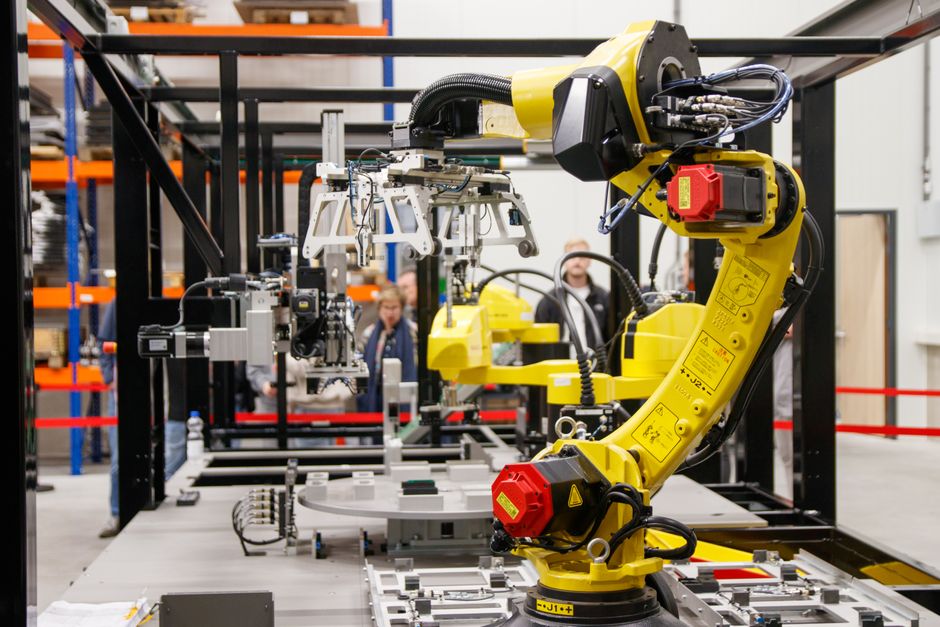
For much of the past two decades, the phrase “made in China” conjured images of vast factory floors staffed by millions of low-wage workers. That image is becoming obsolete. China is now the world’s largest installer of industrial robots, deploying more robotic units per year than Europe and North America combined. Behind this transformation stands a new generation of Chinese robotics companies — Han’s Laser, ESTUN Automation, SIASUN Robot & Automation, and a growing cohort of challengers — that are rapidly closing the technology gap with established Japanese and European rivals while reshaping how global manufacturers source and integrate automation equipment.
For foreign procurement teams, supply chain managers, and industrial investors, understanding this landscape is no longer optional. Chinese robotics is moving from cost competitor to capability competitor, and the implications run deep across sectors from automotive and electronics to pharmaceuticals and food processing.
The Scale Shift: China’s Robot Density Ambitions
In 2023, China installed approximately 276,000 industrial robots, accounting for roughly 70 percent of global new installations according to the International Federation of Robotics (IFR). China’s robot density stood at 392 units per 10,000 manufacturing workers in 2022, surpassing the United States at 285 units and closing on Germany’s 415 units. The government’s 14th Five-Year Plan for Robot Industry Development, issued by China’s Ministry of Industry and Information Technology (MIIT), set a target of doubling domestic robot density by 2025 and achieving annual production of 1 million units from Chinese manufacturers.
This policy push has translated into direct capital: provincial subsidies for robot purchases, preferential land use for robotics manufacturing parks, and state-backed venture capital flowing into automation startups across the Pearl River Delta and Yangtze River Delta.
Han’s Laser: The Laser Processing Giant That Also Builds Robots
Han’s Laser Technology Industry Group, headquartered in Shenzhen’s high-tech corridor, holds roughly 40 percent domestic share in laser cutting and welding equipment and generates over RMB 15 billion (approximately $2.1 billion) in annual revenue. But Han’s Laser has also built one of China’s most integrated automation portfolios.
The company supplies laser-guided robotic welding cells, precision soldering systems for electronics manufacturing, and automated quality inspection lines to customers including BYD, Foxconn, Samsung SDI, and multiple Tier 1 automotive suppliers. Its competitive advantage is vertical: Han’s designs its own laser sources, motion controllers, and vision systems, giving customers a single-vendor solution at 30 to 50 percent lower total installed cost than integrating components from Trumpf, IPG Photonics, and a separate robot OEM.
For Western purchasing managers evaluating automation investments in Chinese manufacturing operations, Han’s Laser is a credible alternative — particularly for battery manufacturing applications where China’s battery supply chain dominance is already driving massive capital expenditure.
ESTUN Automation: The Serious Challenger to ABB and FANUC
ESTUN Automation, listed on the Shenzhen Stock Exchange with a market capitalization above RMB 20 billion, is arguably the most strategically significant pure-play robotics company to emerge from China. Founded in Nanjing in 1993, ESTUN began as a CNC control system maker — giving it deep expertise in the motion control technology at the heart of any industrial robot.
Revenue for 2023 reached approximately RMB 5.8 billion, up from RMB 2.6 billion in 2019, reflecting a compound annual growth rate exceeding 22 percent. ESTUN acquired German machine tool specialist Inotec in 2017 and M.A.i. (a specialist in automotive welding systems) in 2019, giving it European design DNA and market credibility with German-headquartered manufacturers. Its German subsidiary employs over 200 engineers, and it has partnerships with Stellantis and Volkswagen’s Chinese joint ventures.
The traditional calculus — ABB or FANUC for reliability, Kuka or Yaskawa for specific applications — is breaking down. ESTUN and SIASUN are now winning bids for complex automotive body shop applications in China where foreign OEMs previously had near-total lock-in. Western buyers with Chinese operations should include Chinese robotics suppliers in competitive tenders, particularly for welding and material handling applications, electronics and consumer goods assembly, and greenfield investments in Southeast Asia.
SIASUN: The State-Backed Pioneer in Service and Special Robotics
SIASUN Robot & Automation, a spinout from the Shenyang Institute of Automation at the Chinese Academy of Sciences, holds China’s strongest position in collaborative robots (cobots), mobile robots for logistics, and specialty robots for clean room, nuclear, and deep-sea applications. Revenue reached approximately RMB 2.9 billion in 2023.
SIASUN’s cobot lineup competes directly with Universal Robots and Fanuc’s CRX series at prices roughly 30 to 40 percent below Western equivalents. Its autonomous mobile robots are deployed in dozens of Chinese warehouses and increasingly in overseas logistics facilities. Western pharmaceutical companies expanding production in China should note that SIASUN equipment is already standard in many CMO facilities — connecting directly to the broader growth of China’s CDMO and pharmaceutical manufacturing sector.
The Component Supply Chain: Why the Gap Is Closing Fast
Three component categories historically constrained Chinese robot production: harmonic drive reducers, servo motors, and robot controllers. Japanese companies dominated these segments and could effectively limit Chinese robot output by restricting component supply. That constraint is dissolving rapidly.
Shenzhen-based Inovance Technology has become one of China’s leading servo drive and controller manufacturers, supplying Chinese robot OEMs and winning business with European machine tool builders. Shuanghuan Transmission and Leaderdrive are scaling harmonic reducer production at prices well below Japanese equivalents. By 2025, analysts estimate that domestically produced components will account for over 60 percent of inputs in Chinese-brand robots, up from roughly 30 percent in 2018. The playbook mirrors what XCMG and Sany executed in construction equipment: domesticate the supply chain, then compete internationally on value.
US-China Trade Context and Strategic Considerations
Chinese robotics companies face real headwinds in the North American market. The United States Trade Representative (USTR) maintains elevated tariffs on Chinese industrial machinery, and the Commerce Department’s Export Administration Regulations create compliance complexity for Chinese robotics firms attempting to sell into defense-adjacent manufacturing sectors in the US.
The practical effect is that Chinese robotics companies are focusing international expansion on Southeast Asia, Europe (through partnerships), the Middle East, and Latin America rather than direct US market penetration. For Western companies sourcing automation for their Chinese or Southeast Asian operations, however, these restrictions are largely irrelevant — Chinese vendors are fully accessible and increasingly preferred by local plant managers on cost and lead time grounds.
For institutional investors with China access, the sector presents a credible growth story. ESTUN, Inovance, and SIASUN are listed on Chinese domestic exchanges accessible through Stock Connect from Hong Kong. Revenue growth rates of 15 to 25 percent annually, driven by domestic substitution and early-stage international expansion, are achievable across the sector through 2028 even under conservative assumptions about global industrial capital expenditure.
Practical Entry Points for Foreign Buyers and Partners
If you are evaluating Chinese robotics suppliers for the first time, the CIIF (China International Industry Fair), held annually in Shanghai each November, is the most efficient starting point. Every major Chinese robotics company exhibits, with direct access to technical teams, application engineers, and regional distributors.
Due diligence should include verification of after-sales service coverage in your operating geography, confirmation of component sourcing (particularly for reducers and servos), and review of reference installations in your specific application category. For higher-value projects, an on-site audit of the manufacturer’s production facility is standard practice and generally accommodated.
The US International Trade Commission publishes industry data on robotics and automation imports relevant to procurement decisions at usitc.gov.
China’s robotics industry is no longer a story about catching up. Companies like ESTUN and Han’s Laser are setting the terms of competition in specific niches, and the infrastructure of domestic component supply and engineering talent underpinning them is only getting stronger. Whether your interest is procurement, investment, or competitive intelligence, this is a sector that rewards close attention.