
The Company Most of the World Has Never Heard Of
If you ride a subway in Boston, Chicago, or Los Angeles, there is a reasonable chance the cars under your feet were built in China. The company responsible is CRRC Corporation Limited — the state-owned rail giant headquartered in Beijing that now manufactures more trains, metro cars, and locomotives than any other company on earth.
CRRC does not have the brand recognition of Huawei or BYD, but its market footprint is extraordinary. With annual revenues exceeding $30 billion, a workforce of more than 180,000 people, and manufacturing facilities across China and in at least a dozen countries, CRRC has captured the dominant share of global rail equipment procurement over the past two decades. Understanding how it got there is essential for anyone working in infrastructure, logistics, or cross-border investment.
From Two Rivals to One National Champion
CRRC was formed in June 2015 through the merger of China’s two largest state-owned rail equipment manufacturers: CSR Corporation and CNR Corporation. Both had been created from the breakup of China’s Ministry of Railways manufacturing arm in 2000. The logic behind the 2015 consolidation was explicit: CSR and CNR had been competing against each other in overseas bids, undercutting Chinese state interests while helping foreign buyers extract lower prices. By merging them into one entity, Beijing created a national champion capable of competing as a unified force.
The combined company was staggering in scale from day one — market capitalization exceeding $26 billion, product lines covering every rail category from high-speed trains and heavy-haul locomotives to metro cars, trams, and maglev systems. Western competitors including Siemens, Alstom, Bombardier Transportation, and Kawasaki suddenly faced a single Chinese counterpart with state capital backing and preferential financing from China Development Bank and Export-Import Bank of China.
Captive Domestic Demand and Scale Economics
CRRC’s global competitiveness flows directly from a captive domestic market of unparalleled size. China’s high-speed rail network now spans more than 46,000 kilometers — larger than the rest of the world’s high-speed networks combined. Metro systems serve over 50 cities with more than 10,000 km of urban rail lines in operation.
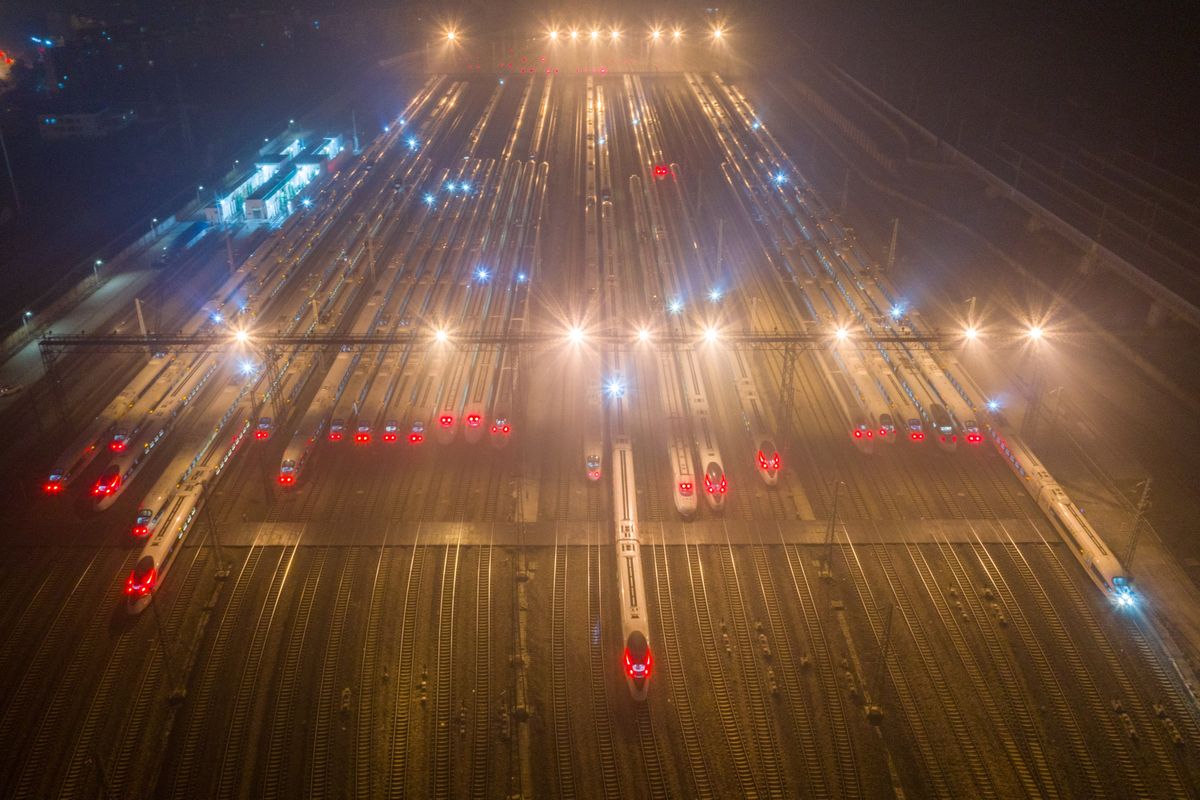
This demand gives CRRC something no competitor can replicate: manufacturing runs at enormous scale on standardized platforms. The CRH380 and CR400 Fuxing high-speed trains have been built by the thousands, allowing CRRC to achieve per-unit costs that foreign rivals cannot match. Each successive domestic procurement cycle funds next-generation R&D — a virtuous cycle Western competitors cannot replicate. The 14th Five-Year Plan committed to adding 3,000 km of new high-speed rail annually through 2025, guaranteeing CRRC a perpetual domestic pipeline regardless of overseas competition.
Global Expansion: Price, Finance, and Local Content
In the United States, CRRC won metro car contracts worth hundreds of millions of dollars in Boston (MBTA), Chicago (CTA), and Philadelphia (SEPTA) between 2014 and 2018. To comply with Buy America rules, it opened a manufacturing facility in Springfield, Massachusetts — the first Chinese rail manufacturer with a US production site. The plant employed American workers and gave CRRC a credible domestic manufacturing claim that complicated congressional opposition.
Those national security concerns ultimately prevailed. The 2020 National Defense Authorization Act prohibited federal transit funding from purchasing rolling stock from Chinese state-owned enterprises, effectively shutting CRRC out of the US municipal transit market. The company pivoted toward Latin America, Southeast Asia, Africa, and Eastern Europe.
In markets where Belt and Road Initiative financing is active, CRRC enjoys a structural advantage: Chinese policy banks often condition financing on procurement from Chinese suppliers. When a government accepts a Chinese-financed rail concession, CRRC frequently wins the rolling stock contract as part of the same package — a bundled model Western competitors cannot replicate without equivalent state-backed financial support.
Technology: Maglev, Hydrogen, and Autonomous Rail
CRRC invests more than $1.5 billion annually in R&D. Its CR400AF-G Fuxing trainset operates at 350 km/h in commercial service — the fastest regularly scheduled rail in the world. China’s experimental maglev test train reached 600 km/h in 2021, and CRRC is developing commercial maglev systems for corridors where even high-speed rail is too slow.
CRRC has also entered hydrogen-powered rail. Its CETROVO hydrogen train entered commercial trial in China, positioning CRRC to compete in European and Asian regional markets previously led by Alstom’s Coradia iLint. Autonomous operations — AI systems that optimize train spacing, energy use, and maintenance — round out a technology portfolio that now competes with Siemens Velaro and Alstom AGV on every engineering dimension.
Competitive Response: Western Rail Consolidates
CRRC’s rise has restructured the Western rail manufacturing landscape. Alstom acquired Bombardier Transportation in 2021 as a defensive consolidation — European regulators had earlier blocked an Alstom-Siemens merger on antitrust grounds, but the strategic logic was precisely the competitive pressure CRRC represented. Siemens Mobility and Hitachi Rail have similarly pursued partnerships to build scale in CRRC-contested markets.
In developing markets, CRRC’s pricing creates real value: metro cars can cost 30 to 50 percent less than European equivalents, all-in including financing. For fiscally constrained governments that differential is decisive. The broader model of Chinese SOEs going global — combining state capital, preferential financing, and captive domestic scale — is exactly what CRRC exemplifies in transportation.
Corporate Structure: Subsidiaries and the Supply Chain Chokepoint
CRRC is dual-listed in Shanghai and Hong Kong, with China’s SASAC retaining majority control. Its subsidiaries reflect deep specialization: CRRC Qingdao Sifang (high-speed trains), CRRC Zhuzhou (locomotives and traction systems), CRRC Changchun (metro cars), CRRC Puzhen (trams), and CRRC Times Electric (power electronics).
Times Electric — separately listed in Hong Kong — is a global leader in train traction systems. It supplies not just CRRC trains but locomotives and EMUs built by competitors. Even train makers that compete with CRRC for contracts often source critical drive systems from CRRC’s supply chain, creating a structural dependency that extends CRRC’s influence beyond the rolling stock contracts it directly wins.
Practical Implications for Procurement and Investment
For infrastructure investors and procurement advisors, CRRC’s dominance creates specific planning requirements. On projects financed through BRI frameworks, understanding CRRC’s role in the equipment supply chain is essential for risk modeling — long-term maintenance, spare parts supply, and technology upgrades all depend on CRRC’s continued engagement.
Component suppliers to the rail sector face both threat and opportunity. As CRRC globalizes and localizes production, it creates procurement demand for local suppliers who meet its quality and cost thresholds. Several European suppliers of brake systems, onboard electronics, and specialized components have built significant revenue streams within CRRC’s international project supply chains.
The US Department of Transportation’s Federal Transit Administration Buy America requirements define the current US regulatory boundary for CRRC. For those working in BRI-adjacent markets, China’s Ministry of Commerce outbound investment database provides reliable transparency on CRRC’s project pipeline and approved contract commitments.
The Bottom Line
CRRC is the clearest example in modern industrial history of how a state-backed national champion uses captive domestic demand, patient capital, and scale economics to become the dominant global player in an advanced manufacturing sector. Its technology is genuine, its quality is competitive, and its engineering depth is real. The political headwinds in North America and Europe reflect both legitimate security concerns and competitive protectionism — often simultaneously.
For professionals working in infrastructure, logistics, or US-China cross-border investment, CRRC is not simply a rail company. It is a case study in how Chinese industrial policy creates global competitors — and a template that sectors from shipbuilding to aerospace are actively replicating. Understanding it is not optional; it is a professional baseline.