
When global retailers like IKEA, Ashley Furniture, and Williams-Sonoma need to fill their showrooms, a significant share of what lands on the shelf was designed, manufactured, and shipped from a single Chinese city: Foshan. Located in Guangdong Province, 28 kilometers southwest of Guangzhou, Foshan has become the undisputed capital of the global furniture industry. In 2023, the city exported over RMB 80 billion (approximately USD 11 billion) worth of furniture and home furnishings, accounting for roughly one-fifth of China’s total furniture export value. For any importer, retailer, or interior design brand operating in global markets, understanding Foshan is not optional.
Why Foshan? The Geography of an Industrial Cluster
Foshan’s dominance is rooted in three structural advantages: deep material supply chains, dense industry clustering, and a policy environment that systematically rewards manufacturing excellence.
The Pearl River Delta, of which Foshan is a core node, sits at the center of one of the world’s most integrated raw material ecosystems. Timber from Southeast Asia and Russia arrives via the ports of Guangzhou and Nansha. Hardware components, fabrics, foam, glass, and metal fittings are sourced from neighboring Zhongshan, Dongguan, and Guangzhou itself. The result is an end-to-end supply chain compressed into a geographic radius that Western manufacturers cannot replicate.
Within Foshan, the furniture industry concentrates around Shunde District and the Lecong-Longjiang corridor, often called the “furniture capital of the world.” The Lecong International Furniture Exposition Center spans over 3.5 million square meters of showroom space, the largest furniture trade complex on the planet. Held twice annually, the China (Shunde) Lecong International Furniture Expo draws buyers from over 100 countries for serious B2B procurement across tens of thousands of SKUs.
For importers, understanding the broader Pearl River Delta manufacturing ecosystem is foundational to grasping why Foshan manufacturers can deliver on cost, lead time, and variety simultaneously.
The Major Players: From OEM Factories to Global Brands
Jason Furniture (喜临门), listed on the Shenzhen Stock Exchange (stock code: 603008) with 2023 revenues exceeding RMB 6.7 billion, exports sofas, mattresses, and bedroom suites to over 60 countries. The company runs a dual “OBM + OEM” strategy: maintaining a robust export manufacturing arm while building its own retail brand domestically.
OPPEIN, China’s largest kitchen cabinet and custom furniture manufacturer, is headquartered in Foshan with 2023 revenues of RMB 7.9 billion. It has won Red Dot Design Awards and operates a dealer network across 80+ countries. Markor International Furniture (美克家居) targets the premium end, with production facilities in the Foshan area and its Markor American Furniture subsidiary operating showrooms across North America.
Beyond these listed companies, the Longjiang-Lecong corridor hosts approximately 1,800 registered furniture manufacturers and an estimated 4,000 component suppliers, the vast majority operating as contract OEM/ODM producers for foreign brands. This invisible factory layer is where most international importers source their products.
Category Depth: Knowing Which District to Source From
The breadth of Foshan’s output is often underestimated by buyers who treat the city as a single sourcing destination. Specific production categories concentrate in specific sub-districts:
- Upholstered furniture (sofas, sectionals, ottomans): Longjiang and northern Shunde. This is Foshan’s single largest export category, accounting for over 40% of total furniture export value.
- Panel furniture (flat-pack wardrobes, TV units, shelving): Dali and Yanbu areas, working heavily to European flat-pack specifications.
- Solid wood furniture: Shunde’s Ronggui sub-district, leveraging imported Southeast Asian teak, rubberwood, and engineered oak.
- Office and commercial furniture: Chancheng District, producing contract-grade office chairs, desks, and hospitality furniture.
Buyers attending China’s Canton Fair in Guangzhou routinely combine the trip with a Foshan factory circuit, given the 30-minute drive between the two cities.
The Tariff Challenge and How Foshan Is Adapting
Section 301 tariffs imposed duties of 25% on the majority of Chinese wooden furniture (HTS Chapter 94), effectively pricing many mid-market Foshan products out of the US mass-market channel. The response has been multi-layered.
A significant segment of OEM production shifted to Vietnam, Cambodia, and Malaysia, with Foshan manufacturers establishing offshore facilities to qualify for lower tariff treatment. Several major Shunde producers now run “China+1” networks where components are sourced from Foshan, assembled in Vietnam, and exported to the US under Vietnamese certificates of origin.
Many manufacturers also pivoted toward Europe, the Middle East, and Australia. The European Union remains the single largest destination for Chinese furniture exports by value, absorbing over USD 8.5 billion annually according to China Customs data. A growing number of Foshan brands have invested in US warehouse and distribution operations, competing on delivery speed against domestic manufacturers rather than pure price.
For importers, the US International Trade Administration’s China resources maintain updated guidance on Section 301 exclusions, antidumping determinations (wooden bedroom furniture has been subject to ADD orders since 2004), and compliance requirements for furniture importers.
Smart Manufacturing and the Industry 4.0 Transition
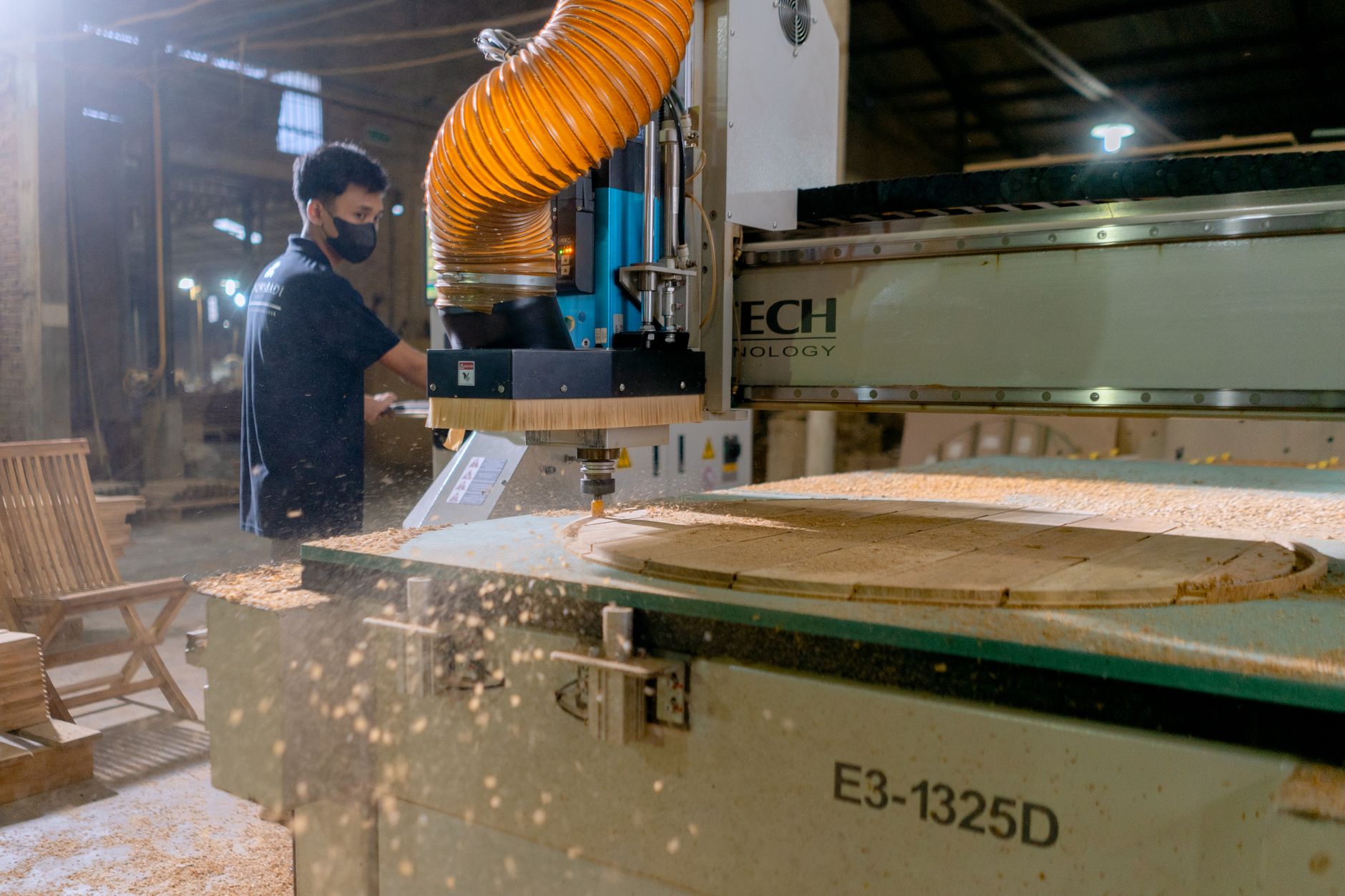
The narrative of Foshan as a labor-intensive factory floor is increasingly outdated. Since 2018, the city government has invested in a “Foshan Smart Manufacturing Initiative,” accelerating automation adoption across the furniture sector. CNC machining centers, robotic spray-painting systems, and AI-driven cutting optimization are now standard equipment at mid-to-large tier manufacturers.
This automation wave has two consequences for international buyers. On the cost side, it partially offsets rising Chinese labor costs, maintaining Foshan’s price competitiveness against Vietnam and Indonesia. On quality, automated production dramatically reduces variability in panel furniture, where millimeter-level tolerances matter for flat-pack assembly. The rise of China’s domestic robotics industry has directly benefited Foshan manufacturers, who are now among the largest non-automotive buyers of industrial automation equipment in the Pearl River Delta.
What Western Buyers Need to Know Before Sourcing
Several practical realities shape the Foshan sourcing relationship. First, minimum order quantities have risen post-pandemic. Most serious manufacturers require full-container loads (20ft or 40ft HQ) for custom specifications; buyers expecting small trial orders will find few takers.
Second, compliance requirements are non-negotiable at scale. US importers must understand Lacey Act compliance for wood products, and the FTC’s Made in USA standards when domestically branding imported goods. European buyers must verify EUTR (EU Timber Regulation) compliance. Leading Foshan manufacturers have this infrastructure; smaller operators may not.
Third, relationship depth matters. Foshan manufacturers differentiate between transactional buyers and strategic partners. Buyers who commit volume, provide clear specifications, and visit regularly are rewarded with priority production scheduling and pricing flexibility. The competitive density of the market means your relationship with your factory principal is your primary competitive advantage over the next buyer who walks through the same showroom door.
Foshan’s trajectory mirrors the broader path taken by Foshan’s home appliance giants Midea and Gree, which made the same journey from contract manufacturer to globally recognized brand over a 20-year arc. The furniture industry is roughly ten years behind on that curve, which means the window for Western buyers to build deep, strategic sourcing partnerships with emerging Foshan brands is still open.
The Bottom Line
No alternative furniture sourcing market, whether Vietnam, Indonesia, India, or Mexico, offers the same combination of category depth, production scale, component ecosystem, and design capability that Foshan delivers. Navigating the tariff and compliance landscape is a cost of doing business, not a reason to exit the relationship. For Chinese manufacturers, the USD 18 billion US furniture import market remains the world’s largest, and the companies investing in compliance, logistics, and brand building today are positioning themselves for the next phase of bilateral trade. Understanding Foshan is understanding how China converts industrial concentration into global market leadership, one category at a time.