
Two thousand years before silicon chips, China was already running the world’s most consequential R&D pipeline. The Four Great Inventions — papermaking, the printing press, gunpowder, and the magnetic compass — did not merely transform ancient trade routes. They created the informational, navigational, and industrial infrastructure upon which every subsequent wave of global commerce was built. Understanding this lineage is not nostalgia. It is a prerequisite for any foreign business professional who wants to understand why China approaches innovation the way it does today.
The Four Great Inventions: A Commercial Lens
Chinese scholars Cai Lun and Bi Sheng are credited respectively with refining papermaking around 105 CE and inventing moveable type around 1040 CE. But for business strategists, the relevant insight is systemic: both innovations reduced the cost of information transmission by orders of magnitude. Papermaking collapsed the per-unit cost of recording and transmitting contracts, maps, and instructions. Moveable type — introduced in China four centuries before Gutenberg — enabled the mass reproduction of commercial standards, legal codes, and trade knowledge.
Gunpowder, first documented in a 9th-century Chinese alchemical text, was initially a controlled military asset. Its commercial derivative — early blast furnace metallurgy techniques derived from gunpowder chemistry — eventually migrated into the industrial revolution’s steel and chemical industries. The magnetic compass, refined in the Song Dynasty (960–1279), reduced navigational uncertainty enough to make the Indian Ocean trade routes commercially viable decades before European sailors attempted them.
The pattern matters: in each case, China developed a foundational technology, scaled it within its own vast domestic market, and then watched it diffuse globally through trade networks and the movement of people and goods. That pattern did not end in the medieval period. It is the operating model of China’s industrial sector today.
From Invention to Industrial Scale: The Modern Manufacturing Arc
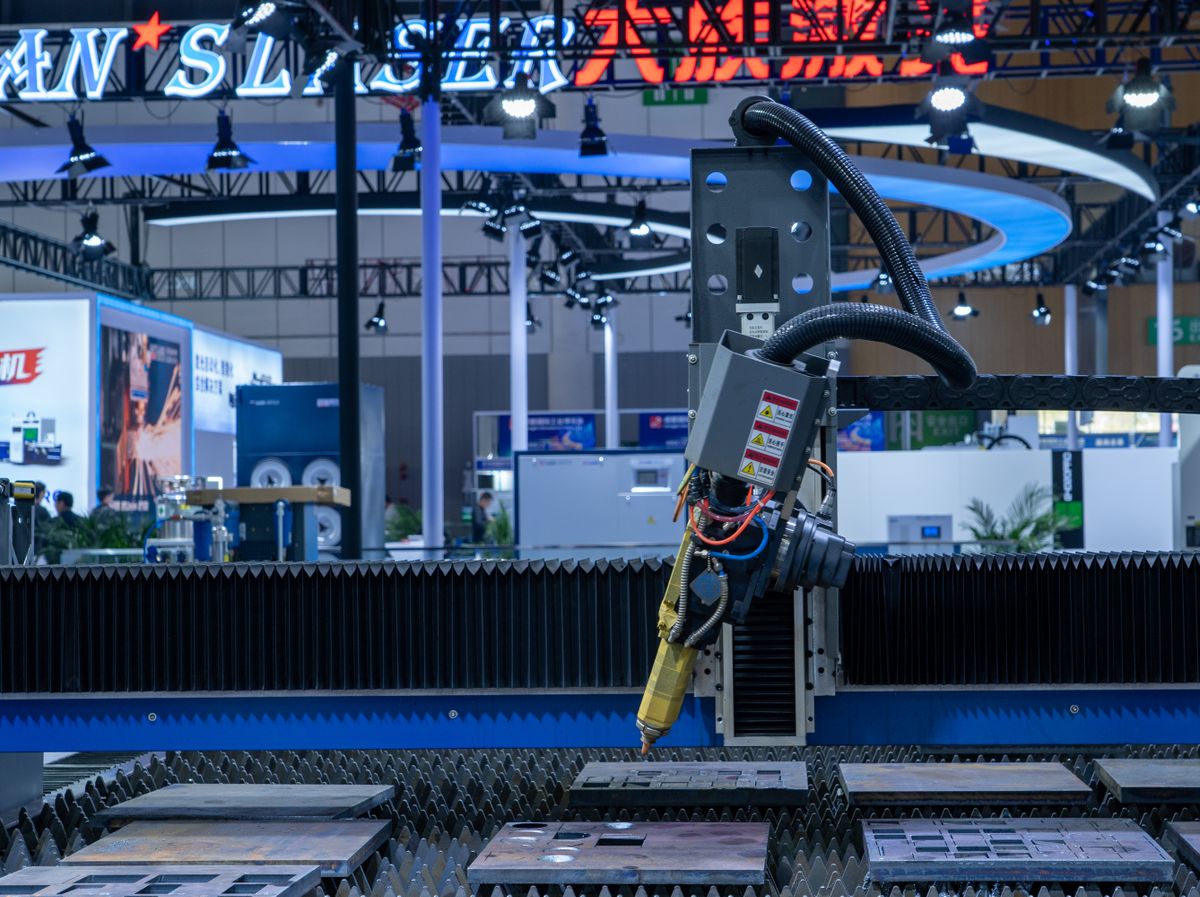
China’s transition from the world’s largest recipient of foreign manufacturing investment to its most formidable industrial exporter took roughly thirty years — an arc that compresses into a single professional lifetime what took Britain two centuries to achieve. The inflection point was the early 1990s, when Special Economic Zones in Shenzhen, Zhuhai, and Xiamen began attracting foreign direct investment under terms that explicitly required technology transfer, joint ventures, and workforce training programs.
By 2010, China had overtaken the United States as the world’s largest manufacturer by output. By 2023, China accounted for approximately 28.8% of global manufacturing value-added, according to data from the United Nations Industrial Development Organization (UNIDO). No other country comes close. The United States, in second place, accounts for roughly 16.8%.
The industries driving this dominance are instructive. Steel output from Baowu Steel Group alone exceeded 131 million tonnes in 2023, more than double the entire annual output of the United States. BYD surpassed Tesla in global EV sales in late 2023, reaching 3 million vehicles sold by end of year. CATL holds approximately 37% of the global lithium-ion battery market. DJI controls an estimated 70-80% of the global consumer drone market. These are not isolated achievements — they reflect a state-directed, supply-chain-integrated approach to industrial competitiveness that traces directly back to deliberate policy choices made at the national level.
Made in China 2025: The Policy Architecture Behind the Innovation Push
In 2015, China’s State Council published “Made in China 2025” (中国制造2025), a ten-year industrial blueprint targeting leadership in ten strategic sectors: next-generation information technology, high-end numerically controlled machinery, aerospace and aviation equipment, maritime engineering equipment, advanced rail equipment, energy-saving and new energy vehicles, power generation equipment, agricultural machinery, new materials, and biopharmaceuticals. The document was explicit in its benchmarks: by 2025, China should achieve 70% self-sufficiency in basic core components and critical basic materials across these sectors.
The strategy drew significant pushback from US trade officials, who argued it constituted discriminatory industrial policy favoring domestic producers. The Office of the United States Trade Representative’s 2018 Section 301 report on China’s technology transfer practices cited Made in China 2025 as a central concern. The resulting tariffs, still largely in place as of 2026, reshaped global sourcing decisions across dozens of industries.
But the underlying industrial momentum has proven resistant to tariff pressure. In semiconductors, China’s domestic chip design capacity has advanced significantly through companies like HiSilicon (Huawei’s design subsidiary), Unisoc, and Cambricon. In electric vehicles, the combination of CATL’s battery cost leadership and BYD’s vertical integration — the company manufactures its own batteries, semiconductors, electric motors, and vehicle bodies — has created a cost structure that Western OEMs cannot replicate at scale.
Innovation Clusters: Where China’s Industrial Genius Is Concentrated
China’s innovation is not uniformly distributed. It clusters around specific geographic nodes, each with a distinct industrial identity. Guangzhou and the Pearl River Delta remain the world’s densest concentration of electronics, garments, and consumer goods manufacturing, with over 50 million workers in a geographic footprint smaller than Pennsylvania.
SMIC and the semiconductor cluster in Shanghai represents China’s most capital-intensive innovation bet: the country has allocated hundreds of billions of yuan in policy bank loans and government investment funds to develop leading-edge chip manufacturing capability, with SMIC reaching 7nm production capability in 2023 under extraordinary resource constraints. Zhengzhou, in Henan Province, hosts the world’s single largest iPhone assembly complex — Foxconn’s Zhengzhou Technology Park employs up to 350,000 workers at peak capacity, illustrating how logistics, labor, and supply chain density create industrial gravity that is extremely difficult to relocate.
Chongqing’s automotive and electronics manufacturing corridor demonstrates that China’s industrial model is not exclusively coastal. With more than 4 million vehicles produced annually and a growing concentration of laptop and tablet manufacturing, Chongqing has used rail freight connectivity — specifically the China-Europe Railway Express — to compensate for its distance from seaports.
The Technology Transfer Debate: What the Historical Record Shows
One of the most contested questions in US-China business relations concerns the degree to which China’s industrial rise depended on technology transfer — voluntary or otherwise — from foreign companies. The historical record is nuanced. Joint venture requirements in sectors like automotive, aviation, and nuclear power did enable Chinese firms to acquire engineering competence they could not have developed as quickly independently. General Motors’ partnership with SAIC Motor, for instance, gave SAIC engineers direct exposure to GM’s global platform development processes — experience that SAIC subsequently applied to developing its own vehicle brands.
But the narrative of pure imitation understates the degree of indigenous engineering capability that China has developed. Huawei’s 5G infrastructure, built on a portfolio of more than 100,000 patents, is not derivative of any foreign predecessor. BYD’s Blade Battery technology — a lithium iron phosphate cell-to-pack architecture that eliminates the conventional battery module layer — was developed entirely in-house and is now licensed by other global manufacturers. CATL’s sodium-ion battery platform, announced in 2021, has no foreign analogue.
The Office of the US Trade Representative’s annual reports on China’s intellectual property practices, available at ustr.gov, provide the US government’s formal assessment of these dynamics. For Chinese companies’ perspective on intellectual property development and international competitiveness, the China National Intellectual Property Administration’s annual report, available at english.cnipa.gov.cn, provides detailed patent filing statistics — China filed more than 1.6 million domestic patent applications in 2023, far exceeding any other country.
What the Innovation Trajectory Means for Foreign Business Partners
For Western companies sourcing from, selling to, or competing with Chinese manufacturers, the shift from cost-competitive producer to innovation-capable competitor changes the strategic calculus in at least three important ways.
First, quality assumptions must be updated. The “cheap but low quality” framework that accurately described Chinese manufacturing in the 1990s is increasingly inapplicable to advanced sectors. Chinese-manufactured high-speed rail infrastructure, for instance, operates at higher speeds with lower defect rates than comparable Western systems — a fact that has enabled CRRC to win competitive tenders in markets as demanding as Boston and Chicago. Foreign procurement teams that maintain outdated quality assumptions will systematically underestimate Chinese bidders.
Second, partnership structures must accommodate Chinese R&D ambitions. Chinese companies entering licensing or joint development agreements increasingly expect genuine co-development rather than technology receipt. Foreign companies that approach Chinese partnerships as vehicles for market access without genuine intellectual contribution will find the terms increasingly unfavorable.
Third, supply chain diversification strategies must account for cluster depth. The concentration of advanced manufacturing capability in specific Chinese geographic clusters — the Pearl River Delta for electronics, the broader cultural and historical roots of Chinese craftsmanship, Zhejiang for machinery and fasteners, Jiangsu for semiconductors and chemicals — means that “China plus one” diversification strategies often encounter a quality and cost gap that takes years to close. The industrial ecosystems that have formed around these clusters took decades to develop and cannot be replicated overnight in Vietnam, Mexico, or India, however attractive those alternatives may appear on a tariff-adjusted cost spreadsheet.
The Long View: Innovation as National Identity
Chinese political culture treats technological and industrial leadership not merely as economic policy but as a matter of national restoration. Xi Jinping’s “China Dream” (中国梦) framework explicitly frames the goal of becoming a “great modern socialist country” by 2049 — the centenary of the People’s Republic — in terms of technological self-sufficiency and industrial leadership. The 14th Five-Year Plan (2021-2025) designated seven areas as “frontier technology” with centralized R&D investment: artificial intelligence, quantum information, semiconductors, brain science, genomics and biotechnology, clinical medicine, and aerospace. The 15th Five-Year Plan, currently in preparation, is expected to extend this list.
For foreign companies, this means that China’s industrial ambitions are structural, not cyclical. Trade tensions, tariff regimes, and diplomatic temperature changes will create volatility. But the underlying trajectory — from the world’s largest manufacturer to the world’s most capable industrial innovator — is unlikely to reverse. The question for any foreign business professional is not whether this transition is happening, but how to engage it constructively on terms that create genuine mutual value. That was, after all, the spirit behind the Four Great Inventions themselves: tools that made the entire world more capable of doing business.