
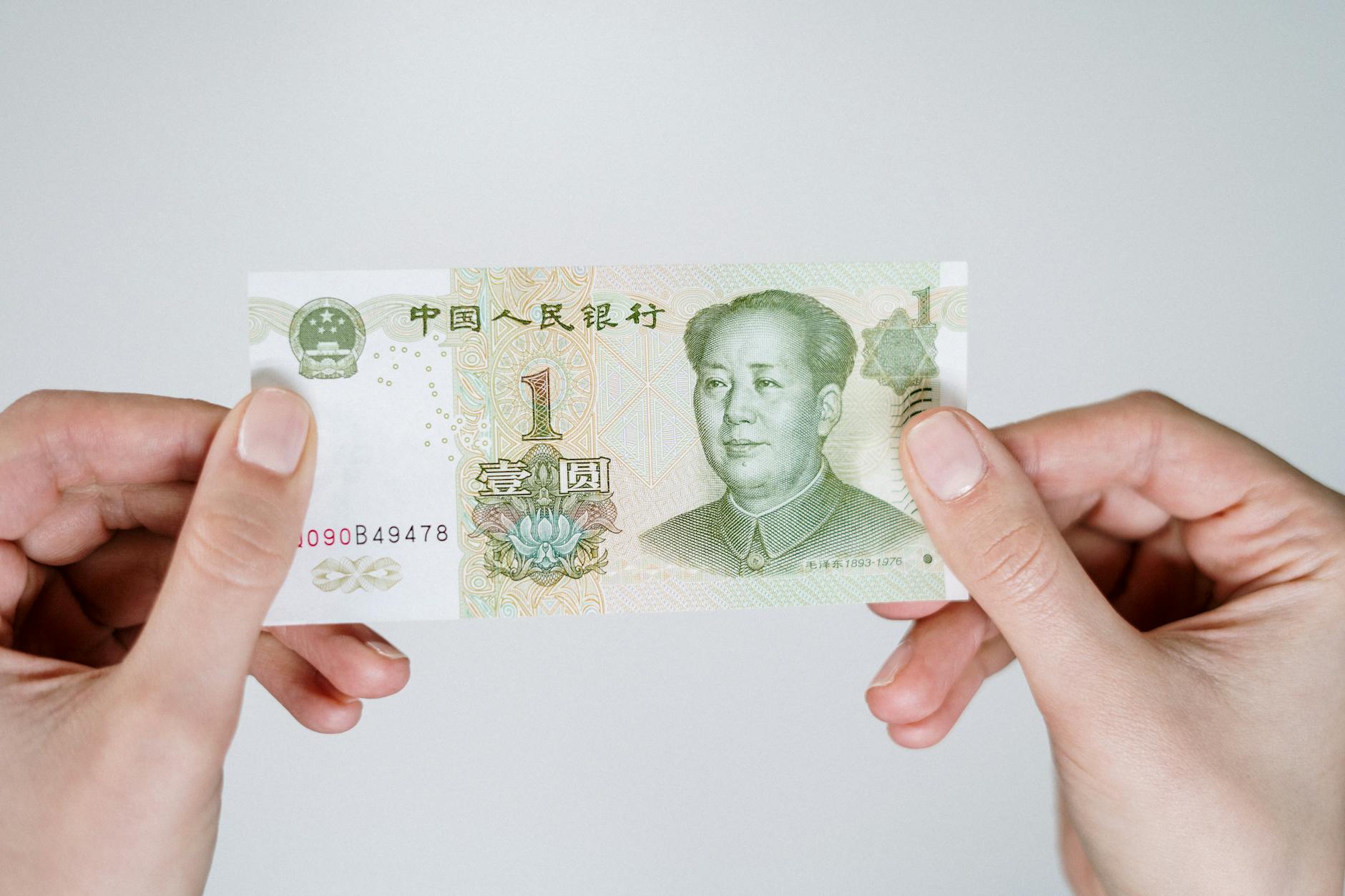
Currency risk doesn’t announce itself. It compounds quietly in the background while you’re focused on production timelines, distributor negotiations, and regulatory compliance. For companies doing business with China, the renminbi (RMB, also called the yuan or CNY) introduces a specific set of exposures that are distinct from other emerging market currencies – because the RMB operates under a managed float, China’s capital controls constrain how you move money, and geopolitical volatility can trigger sharp swings with little warning. Getting this wrong can erode margins you spent years building.
This guide covers the mechanics of RMB exposure, the regulatory framework governing cross-border payments, and the hedging and operational strategies that actually work in China’s environment.
How the RMB Actually Works: CNY vs. CNH
Most businesses don’t realize the renminbi trades in two parallel markets with different rates and different rules.
CNY (onshore RMB) is the rate set in mainland China, tightly managed by the People’s Bank of China (PBOC). Trading is limited to a daily band of ±2% around the PBOC’s daily midpoint fix. If you’re receiving payment from a Chinese buyer or paying a Chinese supplier, you’re dealing with CNY – subject to China’s capital account restrictions and approval requirements for conversion and remittance.
CNH (offshore RMB) trades freely in Hong Kong, Singapore, London, and other offshore centers. The CNH rate is determined by market supply and demand and often diverges from CNY by 0.5-1.5%, sometimes more during periods of stress. For foreign companies invoicing in RMB or holding offshore RMB accounts, CNH is the operationally relevant rate for hedging.
The spread between CNY and CNH is itself a signal. A widening CNH discount (CNH weaker than CNY) typically indicates capital outflow pressure or market pessimism about the Chinese economy. Understanding this dynamic matters when you’re deciding whether to invoice in RMB or USD.
China’s Capital Controls and What They Mean for Your Cash
China’s State Administration of Foreign Exchange (SAFE) governs all cross-border capital flows. This is not a formality – it has direct operational consequences for how and when you can repatriate profits, pay dividends, or transfer funds out of a Chinese subsidiary.
Key rules to know:
- Current account transactions (trade in goods, services) are generally convertible. A Chinese importer can pay a foreign exporter in USD or RMB without special approval, as long as the transaction is supported by commercial documentation (invoice, contract, customs declaration).
- Capital account transactions (equity investment, loans, profit repatriation) require registration and documentation. Dividend repatriation from a wholly foreign-owned enterprise (WFOE) requires corporate resolution, audited financials, and tax clearance certificates – a process that typically takes 4-8 weeks.
- Cross-border loans between a parent and a Chinese subsidiary are subject to macro-prudential limits based on the company’s net assets. SAFE Circular 9 (2016, updated) governs the framework.
- CIPS (Cross-Border Interbank Payment System) is China’s alternative to SWIFT for RMB-denominated transactions. It processes RMB settlements faster and with less documentation friction than USD transactions through correspondent banks, but is only available for RMB-denominated flows.
The practical implication: if you’re running a Chinese subsidiary, your cash is not freely available. Build capital repatriation timelines into your financial modeling. Companies that treat Chinese subsidiary profits as fungible global cash regularly discover they cannot access those funds when they need them.
Sources of RMB Exposure in a Typical Trade Relationship
Currency risk is not just about what currency you invoice in. Exposure arises from multiple points in the value chain:
Transaction Exposure
If you invoice in USD but your Chinese buyer pays 60-90 days later, you have no direct RMB exposure – but your buyer does, and FX volatility affects their pricing sensitivity and payment behavior. If you invoice in RMB (increasingly common as Chinese buyers push for this), you absorb the FX risk directly from contract to payment settlement.
Economic (Operating) Exposure
Even if all your invoices are in USD, a significant RMB depreciation makes Chinese-manufactured substitutes cheaper for your customers everywhere. This is the exposure that most companies miss: it affects your competitive position without appearing on a balance sheet.
Translation Exposure
If you consolidate a Chinese subsidiary, RMB-denominated assets and liabilities must be translated to your reporting currency. A significant RMB move will show up in your OCI (Other Comprehensive Income) line and can affect reported equity. Under IFRS and US GAAP, translation differences on monetary items hit the income statement differently depending on how assets are classified.
Contingent Exposure
If you’re bidding on a long-duration project or supply contract priced in RMB, you carry potential exposure from the moment the bid is submitted. This is often unhedged because the uncertainty of winning makes hedging feel premature – but it’s a real risk.
Hedging Tools Available for China Business
Hedging RMB is more constrained than hedging EUR or JPY, but the toolkit has expanded substantially as the RMB has internationalized.
Forward Contracts (Deliverable and Non-Deliverable)
A deliverable forward (DF) locks in an exchange rate for a future date and requires actual delivery of currency at maturity. DFs are available for CNH through most major international banks and are appropriate for companies that have confirmed RMB receivables or payables with known amounts and timing.
A non-deliverable forward (NDF) settles in USD at maturity based on the difference between the contracted rate and the PBOC fixing rate. NDFs are used for CNY when deliverable settlement isn’t practical, or when you want to hedge onshore exposure from offshore. The NDF market for USD/CNY is deep and liquid, with tenors out to 2 years readily available.
Options
Currency options on CNH give you protection against adverse moves while preserving upside. A vanilla call or put option on CNH is available through major banks, though bid-ask spreads are wider than for G10 currencies. For budget-sensitive hedging programs, options allow you to cap downside without the symmetrical obligation of a forward – at the cost of the premium.
Cross-Currency Swaps
For companies with medium-to-long term RMB-denominated loans or intercompany financing, cross-currency swaps exchange principal and interest payments between currencies. This is the instrument of choice for hedging balance sheet exposure from a Chinese subsidiary’s debt or intercompany loans.
Natural Hedging
The most cost-effective hedge is often structural. If you source from China and sell to China, matching RMB revenues against RMB costs reduces net exposure without market instruments. Similarly, invoicing Chinese customers in RMB while paying Chinese suppliers in RMB creates an internal offset. Companies that are both importers and exporters vis-à-vis China are often naturally hedged to a degree they haven’t quantified.
Practical Hedging Policy: What to Actually Do
A hedging policy should be written down, board-approved, and reviewed at least annually. Ad hoc hedging decisions – made reactively when the exchange rate moves – tend to lock in losses rather than protect margins. Here are the core elements:
Define your exposure horizon. How far in advance can you forecast RMB cash flows with reasonable confidence? For most import/export relationships, 3-6 months is visible. Hedge what you can see; don’t speculate on what you can’t.
Set a coverage ratio. A common approach: hedge 70-80% of forecast exposure within 3 months, 50% from 3-6 months, and leave longer-dated exposure open or use options for protection. This balances certainty against flexibility.
Separate hedging from speculation. Your hedging program should reduce uncertainty, not generate profit. If your finance team is expressing views on RMB direction, you have a speculation problem, not a hedging program.
Choose your bank carefully. Not all banks have the same RMB capability. HSBC, Standard Chartered, Bank of China (BOCHK), Citibank, and JPMorgan Chase are the most liquid providers for CNH hedging products. Your domestic relationship bank may have inferior pricing for RMB-specific instruments.
Document everything. If you’re applying hedge accounting under ASC 815 (US GAAP) or IFRS 9, you need formal designation, contemporaneous documentation of the hedging relationship, and ongoing effectiveness testing. Get your auditors involved before you start, not after.
PBOC Policy and What Signals to Watch
The RMB does not float freely, but it does move – and PBOC intervention signals are readable if you know what to watch.
- Daily midpoint fix: Published by the PBOC each morning, this is the most direct signal of the central bank’s near-term exchange rate intent. A persistent pattern of stronger-than-expected fixes signals the PBOC is defending the currency; weaker fixes indicate tolerance for depreciation.
- Foreign exchange reserve levels: SAFE publishes monthly FX reserve data. A significant drawdown suggests PBOC intervention selling USD to support the RMB – and its limits.
- Required reserve ratio for FX deposits: The PBOC has used RRR adjustments for FX deposits as a macro-prudential tool to manage appreciation or depreciation pressure. A reduction in the FX RRR reduces onshore USD supply and strengthens the RMB; an increase does the opposite.
- Counter-cyclical adjustment factor: Introduced in 2017 and periodically activated, this factor in the PBOC’s fixing formula allows the central bank to dampen pro-cyclical moves. When it’s active, the fixing rate will diverge from what pure model-based calculation would produce.
For ongoing intelligence on PBOC policy and RMB movements, the Reuters FX markets coverage and the SAFE official website are the primary sources. SAFE’s English-language section publishes circulars, reserve data, and policy guidance.
Structuring Contracts to Reduce Currency Risk
Before reaching for a hedging instrument, consider whether your contracts can be structured to reduce gross exposure:
- USD invoicing with price escalation clauses: If your Chinese counterpart insists on RMB stability but you need USD, a force majeure-style FX clause that allows price renegotiation if the rate moves beyond a defined band is increasingly accepted in long-term supply contracts.
- Payment timing: Shorter payment terms reduce the window of exposure. Negotiating 30-day terms instead of 90-day terms on RMB-invoiced sales cuts your forward exposure by two-thirds.
- Offshore RMB accounts: Holding a CNH account in Hong Kong allows you to accumulate offshore RMB and deploy it for China-related payments without going through the onshore conversion process, reducing both time and documentation friction.
Managing currency risk in China-related business is inseparable from a broader understanding of cross-border compliance. Companies navigating these issues alongside tariff and trade policy pressures should also review our guide to US-China trade in 2026: tariffs, restrictions, and what businesses need to know, as tariff-driven pricing adjustments and FX hedging decisions often interact in ways that require coordinated financial planning.
For companies operating Chinese subsidiaries and managing the capital account side of these flows, the legal structure of your China entity significantly shapes what you can do. Our overview of how China’s economy and SOE structure affect foreign businesses provides context for the regulatory environment you’re operating within.
Supply chains that span both China-sourcing and China-selling create the most complex FX profiles. Our US-China supply chain risk guide covers the operational layer, while this article addresses the financial layer – the two should be read together.
For companies whose China business involves cross-border payments infrastructure, our guide to protecting intellectual property in China is also relevant – IP licensing structures frequently create RMB royalty flows that require their own hedging treatment.
For authoritative regulatory guidance, the US-China Business Council’s annual member surveys consistently document the FX and capital account issues that US companies operating in China identify as top operational challenges – a useful benchmark for calibrating your own exposure management priorities.
The Bottom Line
Managing RMB exposure is not optional for companies with meaningful China business. The combination of managed-float dynamics, capital controls, and periodic geopolitical volatility creates a currency environment that rewards preparation and punishes improvisation. The right approach is to quantify your exposure across transaction, economic, and translation dimensions; establish a written hedging policy with defined coverage ratios; and use the right instruments for each type of exposure – forwards for confirmed flows, options for contingent exposure, and natural hedging where the business model allows.
The companies that handle this well treat it as a core finance discipline, not an afterthought. The ones that don’t tend to discover their exposure at the worst possible moment.