
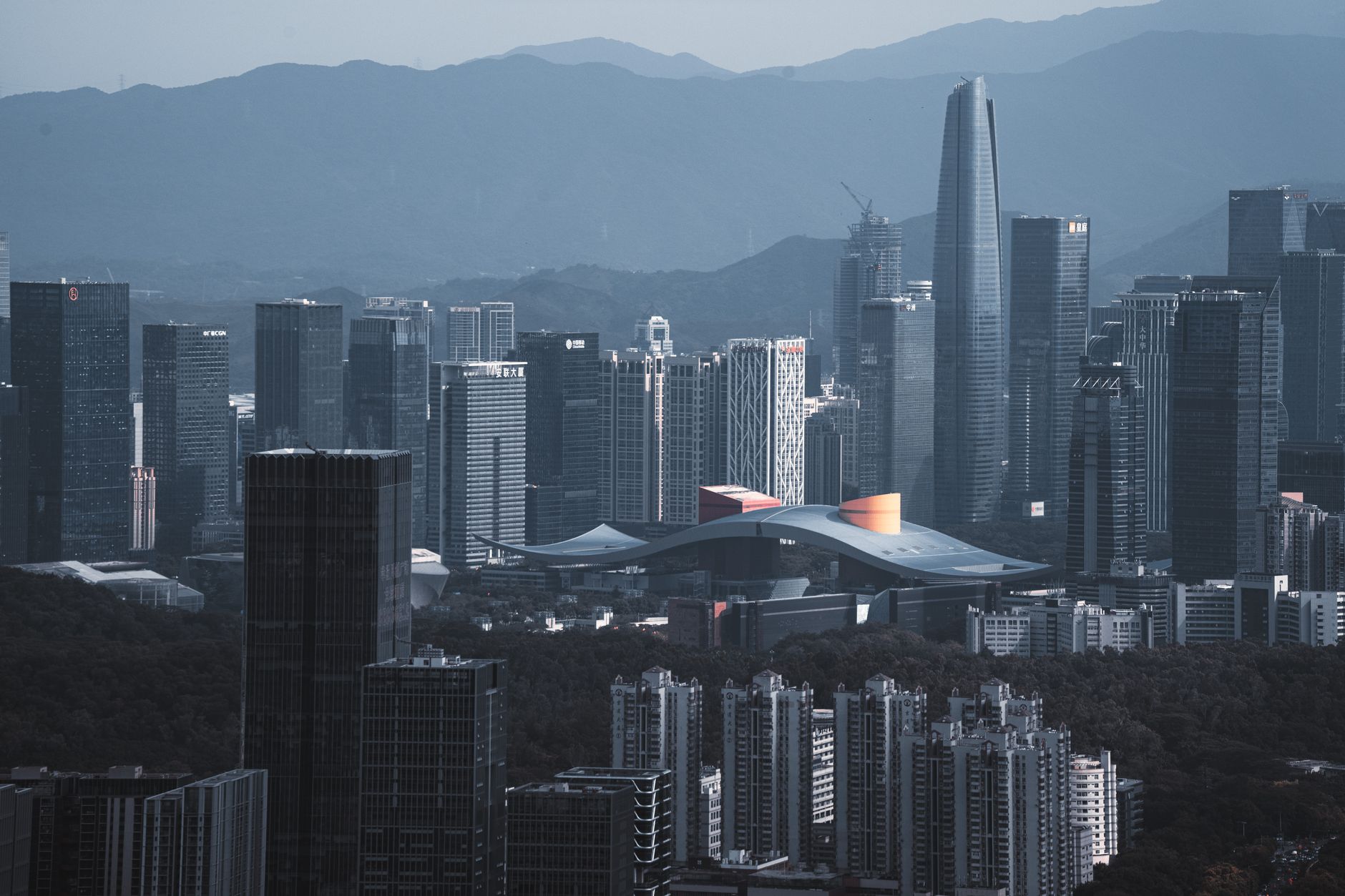
In 1979, Shenzhen was a fishing village of roughly 30,000 people, separated from Hong Kong by a narrow stretch of water and decades of economic divergence. Today it is home to 17 million residents, generates a GDP exceeding $560 billion USD, and sits at the center of the most consequential technology supply chain on earth. No city in modern history has moved from subsistence economy to global innovation powerhouse within a single generation — and for any executive navigating US-China business, understanding that transformation is not optional.
The Special Economic Zone That Changed Everything
Shenzhen’s origin story begins with a political decision, not a geographic advantage. In 1980, Deng Xiaoping designated it as China’s first Special Economic Zone (SEZ) — a deliberate laboratory for market-oriented reforms that the rest of China was not yet ready to absorb. Foreign investment was permitted. Private enterprise was tolerated. Labor could move more freely than anywhere else in the country.
The results were immediate and dramatic. Foreign manufacturers, particularly from Hong Kong and Taiwan, poured capital into the new zone. Export-processing factories multiplied across the lowlands north of the border. By the mid-1990s, Shenzhen had become the dominant assembly point for consumer electronics destined for Western markets. Toys, garments, footwear, printed circuit boards — if it was assembled and shipped, odds were strong it touched Shenzhen.
The city’s GDP grew at an average annual rate exceeding 25% for most of the 1980s and 1990s. By 2010, it had surpassed Hong Kong’s GDP in nominal terms. The Pearl River Delta region — of which Shenzhen forms the eastern anchor — became the world’s single largest manufacturing cluster, accounting for a substantial share of global electronics output.
From Assembly Line to R&D Campus
The pivot from pure manufacturing to innovation did not happen overnight. It required deliberate policy engineering, a critical mass of engineering talent, and a culture that — unusually for China — rewarded entrepreneurial failure rather than punishing it.
Shenzhen’s government invested heavily in building out Nanshan District as a technology corridor during the 2000s. Tax incentives for high-technology enterprises were layered on top of the existing SEZ framework. Renmin University, Peking University, and Tsinghua all established Shenzhen campuses, creating a local talent pipeline that no longer depended entirely on migration from inland provinces.
The city also developed a uniquely open hardware ecosystem — the so-called Shanzhai culture — in which component vendors, PCB fabricators, firmware developers, and assemblers clustered within a few square kilometers of each other. A hardware startup could prototype a product, source components, manufacture 500 units, and ship them internationally within weeks. This density of supply-chain capability proved to be an incubator for companies that eventually went global.
The Companies That Emerged
The corporate roster that Shenzhen produced is extraordinary by any measure.
Huawei was founded in 1987 by Ren Zhengfei, a former People’s Liberation Army engineer, in a small Shenzhen apartment. Starting as a reseller of telephone switches imported from Hong Kong, the company spent decades investing in R&D at a rate that few Western peers could match — consistently 10% or more of annual revenue. By 2024, Huawei’s R&D expenditure exceeded $23 billion USD. The company today employs over 200,000 people globally and holds more international patents than any Chinese corporation. Its story — including the geopolitical turbulence of US sanctions — is explored in depth in our full analysis of Huawei’s rise and the implications for global tech supply chains.
Tencent was founded in 1998 by Ma Huateng (Pony Ma) and four co-founders in a Shenzhen office building. Beginning with a desktop instant-messaging product called OICQ (later QQ), Tencent built what became one of the world’s largest technology conglomerates. Its flagship product WeChat had 1.36 billion monthly active users as of 2024. Tencent’s investment portfolio spans Riot Games, Epic Games, Snap, and stakes in over 800 companies globally.
DJI — Da-Jiang Innovations — was founded in 2006 by Frank Wang (Wang Tao), a Shenzhen University graduate who built his first drone prototype in a dormitory. Today DJI controls approximately 70% of the global commercial drone market, generating estimated annual revenues of $4-5 billion USD. The company’s ability to vertically integrate flight controllers, camera gimbals, propulsion systems, and software within a single Shenzhen facility is a masterclass in the manufacturing ecosystem advantage that Shenzhen uniquely provides.
BYD (Build Your Dreams) was founded in 1995 by Wang Chuanfu as a rechargeable battery manufacturer and has since become the world’s largest electric vehicle company by unit sales. BYD’s headquarters remain in Shenzhen. In 2023, BYD sold 3.02 million vehicles globally, surpassing Tesla in total EV sales for the year.
The Innovation Infrastructure: What Makes Shenzhen Different
Shenzhen’s continued dominance in hardware innovation rests on a set of structural advantages that other cities have struggled to replicate — including cities in China itself.
Supply chain density. Huaqiangbei, a neighborhood in Futian District, is the world’s largest electronics market. More than 20,000 vendors occupy its interconnected malls. Every conceivable component — from custom ASIC chips to obscure sensor modules — is physically available within walking distance. For a hardware engineer, proximity to this market compresses development cycles by weeks or months.
Manufacturing flexibility. Shenzhen’s contract manufacturers — including Foxconn’s large Longhua campus, which assembles iPhones and hosts over 200,000 workers at peak capacity — can scale production volumes in ways that no other geography currently matches. The logistics infrastructure (Yantian International Container Terminal, Bao’an International Airport) ensures that finished goods reach ports quickly.
Talent retention. Unlike many Chinese cities where ambitious professionals eventually migrate to Beijing or Shanghai, Shenzhen has developed a strong holding power. Compensation at Shenzhen tech companies rivals or exceeds Beijing norms. Housing, while expensive, is newer. And the culture — younger, less bureaucratic, more meritocratic — attracts and retains engineers who want to build products rather than navigate political hierarchies.
Regulatory experimentation. Shenzhen continues to function as a testing ground for policy innovation. In 2020, Beijing designated it as a pilot zone for deeper socialist market reforms, granting expanded authority over land use, capital flows, and fintech regulation. The Qianhai Free Trade Zone — located on Shenzhen’s western coast — offers further preferential treatment for financial services and cross-border business activities.
What the US-China Tech Tension Means for Shenzhen
The escalation of US-China technology restrictions since 2018 has directly targeted Shenzhen’s most advanced capabilities. Export controls on advanced semiconductors (particularly NVIDIA GPUs and ASML lithography equipment), restrictions on Huawei’s access to US components, and the Entity List designation of dozens of Shenzhen-based firms have forced significant adaptation.
The Chinese government’s response has been to accelerate domestic semiconductor development through SMIC and to fund a network of new chip design companies. Shenzhen itself has invested heavily in attracting semiconductor design talent, offering subsidies of up to 30% of R&D costs for qualifying chip firms. The US Department of Commerce’s Bureau of Industry and Security (BIS) maintains an updated Entity List that any company sourcing from or selling to Shenzhen-based firms should review as a matter of compliance routine.
For Western companies, this creates a bifurcated reality. On one hand, Shenzhen’s manufacturing capabilities remain largely accessible and commercially compelling. Consumer electronics, automotive components, solar products, industrial equipment — none of these categories are broadly restricted. On the other hand, any engagement with advanced technology transfer, joint R&D, or investment in Shenzhen-based firms now requires careful legal review under the Export Administration Regulations (EAR), the Foreign Direct Product Rule, and — for US-listed companies — OFAC screening requirements.
Shenzhen as a Template for China’s Broader Ambitions
Beijing has explicitly used Shenzhen as the model for subsequent development initiatives. The Hainan Free Trade Port, announced in 2020 and slated for full implementation by 2025, borrows heavily from the Shenzhen SEZ playbook — zero tariffs on most goods, simplified business registration, and significant labor mobility. China’s Ministry of Commerce regularly publishes updated guidance on the MOFCOM official website regarding investment policies in designated development zones, including Shenzhen’s Qianhai district.
The Guangdong-Hong Kong-Macao Greater Bay Area (GBA) initiative further integrates Shenzhen with Hong Kong, Macao, and eight other Pearl River Delta cities into a single economic zone targeting a combined GDP of $4 trillion USD by 2030. For foreign companies, this means Shenzhen’s advantages are increasingly accessible alongside Hong Kong’s common law legal system and international financial infrastructure — a combination that is genuinely compelling for regional headquarters decisions.
Practical Implications for Western Business Leaders
Whether you are sourcing electronics components, evaluating manufacturing partners, considering R&D collaboration, or assessing competitive threats from Shenzhen-based companies, several practical frameworks apply:
Conduct supplier audits in person. Shenzhen’s contract manufacturing market rewards buyers who invest in relationships. Factory visits — coordinated through third-party quality assurance firms such as Bureau Veritas, SGS, or TUV — consistently yield better pricing, faster development timelines, and more reliable quality control than purely remote engagement.
Engage with the local technology ecosystem deliberately. Shenzhen hosts the China Hi-Tech Fair (CHTF) every November — the largest technology exhibition in Asia, drawing over 700,000 visitors and 5,000 exhibitors annually. Attendance is one of the highest-ROI activities available to Western executives seeking to assess Chinese technology capabilities firsthand.
Structure IP protections carefully. Shenzhen’s pace of product development is fast precisely because local firms iterate on existing designs. For US companies, the International Trade Administration (Commerce.gov) provides resources on IP protection and market access in China. Foreign companies operating in the city should ensure that non-disclosure agreements are governed by Chinese law (enforceable locally), that trade secret registrations are filed with China’s National Intellectual Property Administration (CNIPA), and that software code is protected through copyright registration before any local disclosure.
For a deeper understanding of how to navigate your on-the-ground operations in Shenzhen — including office setup, hiring, banking, and daily logistics — see our comprehensive Doing Business in Shenzhen guide.
The Verdict
Shenzhen is not a manufacturing story anymore. It is a technology story — one still being written. The city that assembled the world’s toys and phones has become the city that designs the world’s drones, electric vehicles, and telecommunications infrastructure. For Western companies, that dual identity is both an opportunity and a challenge: a place where the supply chain advantages of manufacturing density now coexist with companies competing directly for global market leadership.
The executives who understand this transition — who see Shenzhen not just as a sourcing destination but as a competitive force — will be better positioned to make decisions that account for where China’s technology sector is actually headed, rather than where it was a decade ago.